What Is a Prop Firm? The Plain-English Answer
What a prop firm is, the two kinds, how online firms work, and what you actually risk. In plain English.
On this page

The short answer: A prop firm (short for proprietary trading firm) is a company that lets traders trade its account instead of their own money, and splits the profits with them. Today most people mean online evaluation firms, where you pay a fee, pass a set of trading rules, and earn a share of what you make on a funded account.
Key takeaways
- "Prop" means proprietary: trading the firm's account, not a client's or your own.
- There are two kinds: traditional firms you get hired into, and online evaluation firms you buy into.
- Online firms make most of their money from evaluation fees.
- Your real money at risk is the fee, not the account size.
What does "prop" mean in prop trading?
"Prop" is short for proprietary, meaning the firm trades its own account rather than managing customers' money. Banks and trading firms have run proprietary desks for decades. The online version opened that idea to anyone with an internet connection and a card.
What are the two kinds of prop firm?
Traditional firms hire or accept traders and give them firm capital; evaluation firms sell tests and fund the people who pass.
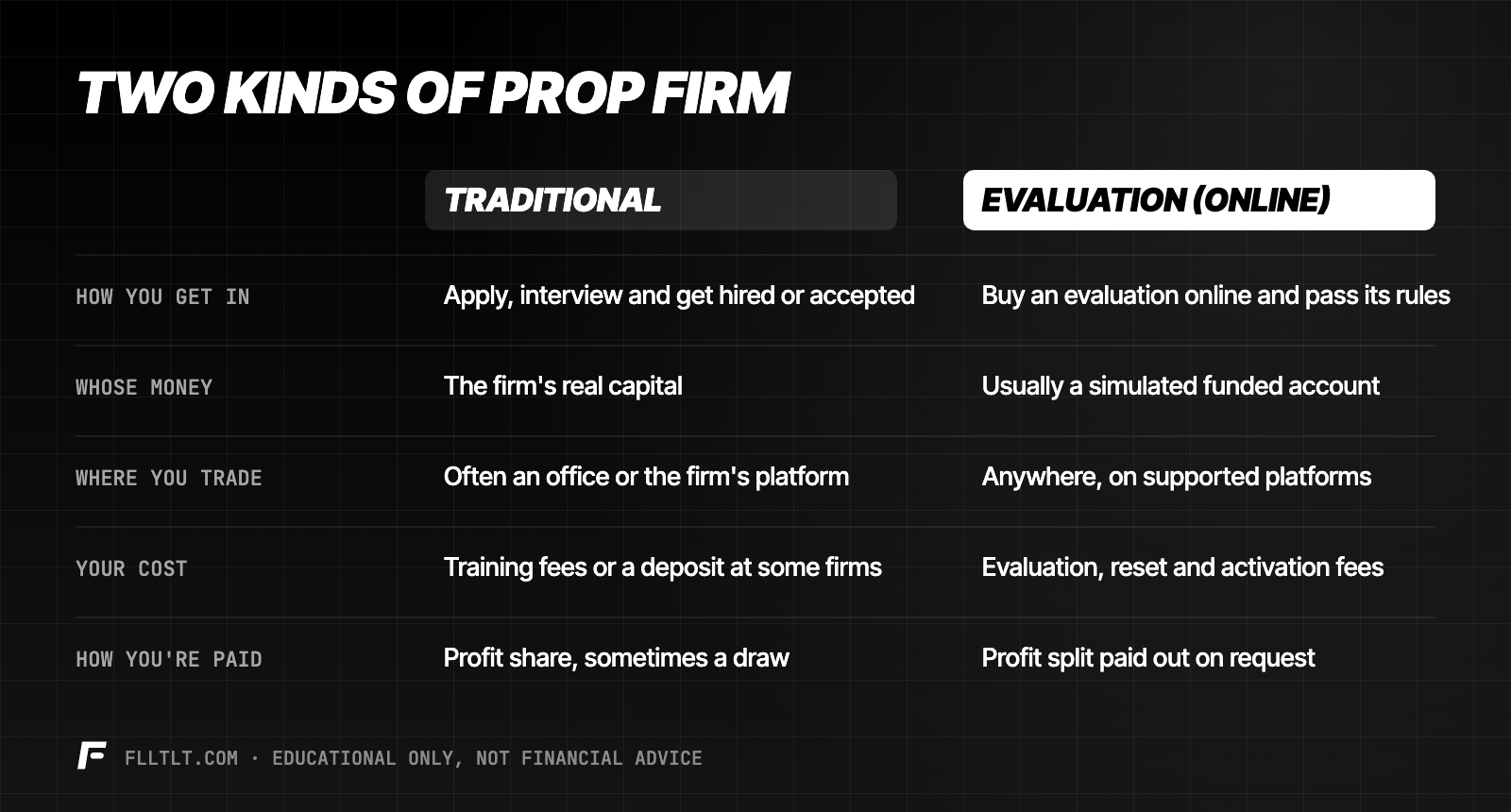
Traditional firms look more like a job: you apply, train and trade under a risk manager. Evaluation firms look more like a game with rules: you pick an account size, try to hit a profit target without breaking a drawdown limit, and get funded if you pass. The rest of this guide is about evaluation firms, because that's what most traders are searching for.
How does an online prop firm work?
You buy an evaluation, pass its rules, get a funded account and request payouts. A typical futures evaluation has a profit target, a maximum drawdown, sometimes a daily loss limit, a consistency rule and a cap on contracts. The full walkthrough, with real numbers, is in Prop Firm Trading: The Complete Guide.
What do you actually risk?
The fee. If a 50K evaluation fails, you don't owe the firm $50,000 or any losses. You lose what you paid for the evaluation, and any resets you buy after it. That's why the smart way to think about fees is as tuition with a cap.
From the desk Indy trades MNQ futures and publishes his rules-only record in points on Day Trader Income. His advice to anyone new: paper trade on TradingView until your results hold up, before you spend money on an evaluation.
Who are prop firms for?
- Good fit: traders with a tested plan who want to trade a bigger account than they can fund, and can follow rules under pressure.
- Bad fit: brand-new traders hoping an evaluation will teach them to trade, and anyone using money they can't afford to lose on fees.
Common mistakes
- Thinking the account size is the prize. A 150K account with a tight drawdown can be harder than a 50K one.
- Treating it like a lottery ticket. Buying evaluation after evaluation without changing anything is how fees pile up.
- Skipping the rules page. Every firm's rules are different, and the fine print is where accounts fail.
The bottom line
A prop firm lets you trade its account for a share of the profits. Online firms make it accessible to anyone, but you're buying a test, not a job. Learn the rules, size from the drawdown, and start with paper trading. For the full picture, read the complete guide to prop firm trading.
FAQ
Is a prop firm the same as a broker?
No. A broker executes trades in your own account with your own money. A prop firm gives you access to its account or a funded account under its rules, and shares the profits with you.
Do prop firms give you real money?
Traditional firms trade real capital. Most online evaluation firms run evaluations and many funded accounts in a simulated environment, but the payouts they send you are real money.
How much does it cost to join a prop firm?
At online firms you pay for an evaluation, usually a one-time fee or a monthly subscription that rises with account size, plus possible reset and activation fees. Traditional firms vary, from free training programs to firms that require a deposit.
What does "funded trader" mean?
A funded trader is someone who passed a firm's evaluation and now trades a funded account, keeping a share of the profits.