Your First Week as a Funded Trader
You passed the evaluation. Here is how to handle the first week funded: new rules, smaller size, building a cushion and planning your first payout.
On this page
The short answer: Your first week as a funded trader should look boring. Reread the funded account rules, because they're often different from the evaluation. Trade smaller than you did to pass, build a profit cushion above your drawdown before you increase size, and learn the payout terms before you need them. Most funded accounts that fail early fail because the trader treated passing as permission to trade bigger.
Key takeaways
- Funded accounts often have different rules from the evaluation. Read them again.
- Your drawdown usually starts close to the balance again. You have no cushion yet.
- Start smaller, not bigger, until profits build a buffer.
- Know the payout schedule, minimums and terms in advance.
- Keep doing exactly what passed the evaluation.
What changes when you get funded?
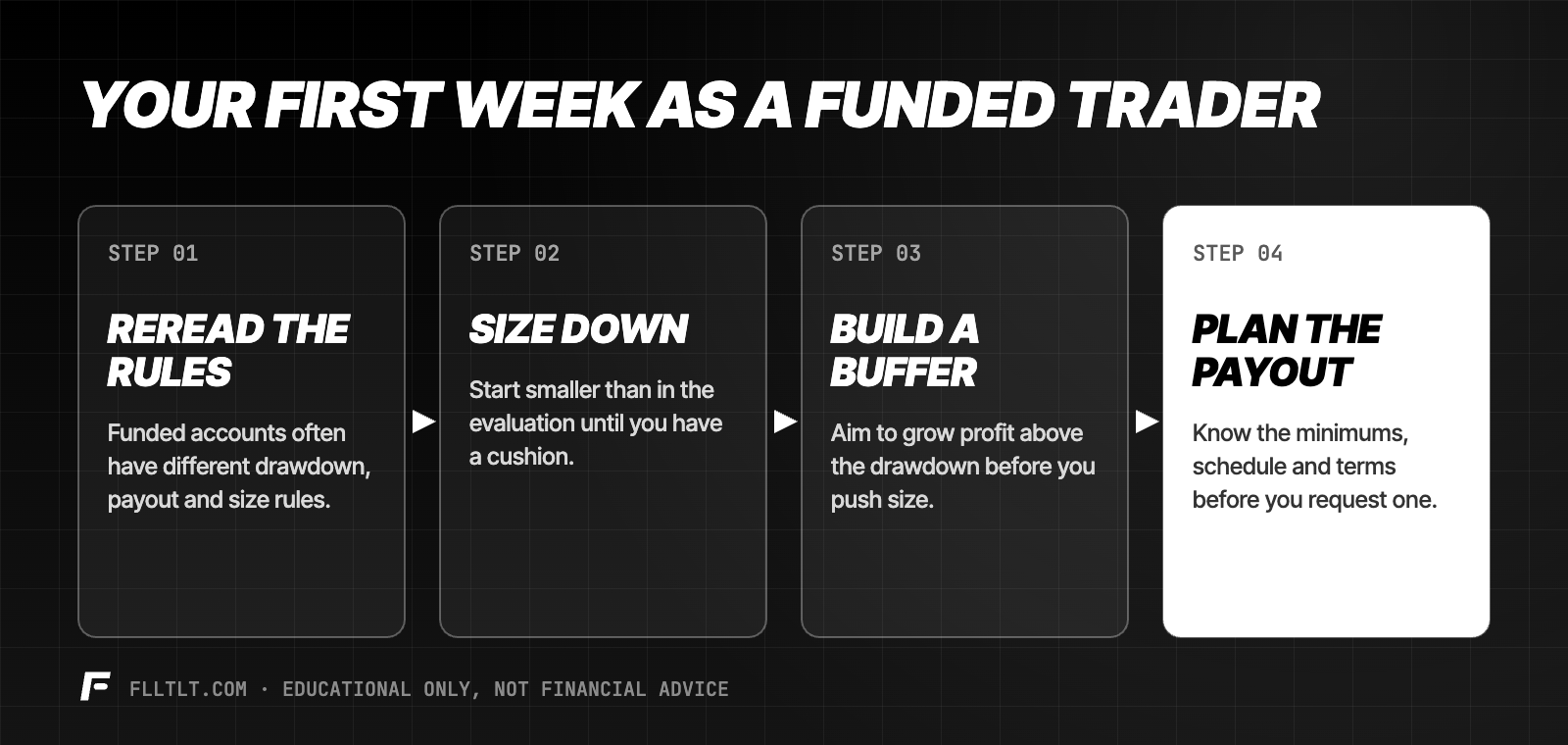
Often the rules, and always the pressure. Many firms change something between the evaluation and the funded account: the drawdown type, the daily limit, a consistency rule for payouts, contract limits that scale with profit, or a minimum number of trading days before a payout. Read the funded rules line by line, even if you know the evaluation rules by heart.
Why does the first week matter so much?
Because you start with no cushion. In most funded accounts, your drawdown resets relative to the new account. Whatever room you built in the evaluation is gone. A $2,000 trailing drawdown on day one means you're $2,000 from losing the account, the same as on the first day of the evaluation, but now it feels like there's more to lose.
Should you trade bigger once you're funded?
No. Trade smaller at first. It's tempting to think "now it counts" and size up. That's backwards. The goal of the first week or two is to put profit between your balance and your drawdown. Once you have a cushion of several losing trades, you can return to normal size.
| Stage | Cushion above drawdown | Suggested risk per trade |
|---|---|---|
| Day one | None | Half your normal risk |
| Building | 3–5 losing trades' worth | Normal risk |
| Established | Well above your drawdown | Normal risk; scale slowly if rules allow |
Not sure what "normal" is? See how much to risk per trade.
What should you know about payouts before your first one?
Everything, before you request it. Check:
- When you can request: some firms require a minimum number of trading days or winning days.
- Minimum and maximum payout amounts, and whether early payouts are capped.
- Consistency rules that only apply at payout. See consistency rules, explained.
- What a payout does to your drawdown. At some firms, withdrawing profit lowers your cushion or changes where the drawdown sits.
- How you get paid and what tax paperwork to expect. Read prop firm vs your own account for the tax basics.
What mistakes do new funded traders make?
- Sizing up on day one. The most common one, by far.
- Changing the strategy. What passed the evaluation is what you know works. Don't add new setups now.
- Trading to hit a payout date. Forcing trades to qualify by a certain day leads to overtrading.
- Ignoring a new rule. A funded-only rule you didn't read is the worst way to lose an account.
From the desk Indy trades MNQ and keeps a rules-based record in points on Day Trader Income. The habit that matters most after passing is the one that got you there: same setups, same points-based stops, same daily stop. The account changed. The plan doesn't have to.
What should your first funded week look like?
- Before day one: reread the funded rules and write down the three that matter most.
- Days one to three: half size, your best setup only, hard daily stop.
- Days four and five: if you've built a cushion, move toward normal size. If not, stay small.
- End of week: review every trade. Did you follow the plan? That's the only score that counts this week.
The bottom line
Passing the evaluation proved you can follow rules. The first funded week proves you can keep doing it when it feels real. Read the new rules, trade small, build a cushion and know the payout terms. Then let the account grow the same way it passed: one planned trade at a time. Start with the basics in risk management for funded traders.
FAQ
What should I do after passing a prop firm evaluation?
Reread the funded account rules, since they often differ from the evaluation. Then trade smaller at first, build a profit cushion above the drawdown and learn the payout terms.
Should I trade bigger once I am funded?
No. Your drawdown usually starts close to the balance again, so you have no cushion. Trade smaller until profits build a buffer, then return to normal size.
Do funded accounts have different rules than evaluations?
Often, yes. Firms may change the drawdown type, daily limits, consistency rules, contract limits or payout requirements.
When can I request my first prop firm payout?
It depends on the firm. Many require a minimum number of trading days or winning days and set minimum and maximum payout amounts.
Why do funded accounts fail quickly?
Usually because the trader sizes up right after passing, changes strategy or misses a funded-only rule while there is no profit cushion yet.