Risk Management for Funded Traders
Risk per trade, position sizing, stops, expectancy and daily limits for prop firm traders, with the formula and futures point values.
On this page
The short answer: Risk management for funded traders comes down to three numbers: how much you risk per trade, where your stop is, and how much you can lose in a day. Size every trade from the drawdown, put the stop where your idea is proven wrong, and adjust the contract count to fit. Do that consistently and a losing streak becomes survivable.
Key takeaways
- Risk 5–10% of your drawdown per trade, in dollars, decided before the entry.
- Place stops where the trade idea is wrong, then size contracts to fit the stop.
- Contracts = dollar risk ÷ (stop in points × point value).
- A positive expectancy matters more than a high win rate.
- Correlated positions, like ES and NQ, count as one bigger trade.
How much should you risk per trade?
Pick a fixed dollar amount equal to 5–10% of your maximum drawdown, and use it on every trade. The smaller the percentage, the longer you survive a bad run.
| Drawdown | 5% risk | 10% risk | Losses to fail at 10% |
|---|---|---|---|
| $1,000 | $50 | $100 | 10 |
| $2,000 | $100 | $200 | 10 |
| $3,000 | $150 | $300 | 10 |
| $4,500 | $225 | $450 | 10 |
How do you size a position?
Divide your dollar risk by what one contract loses at your stop.
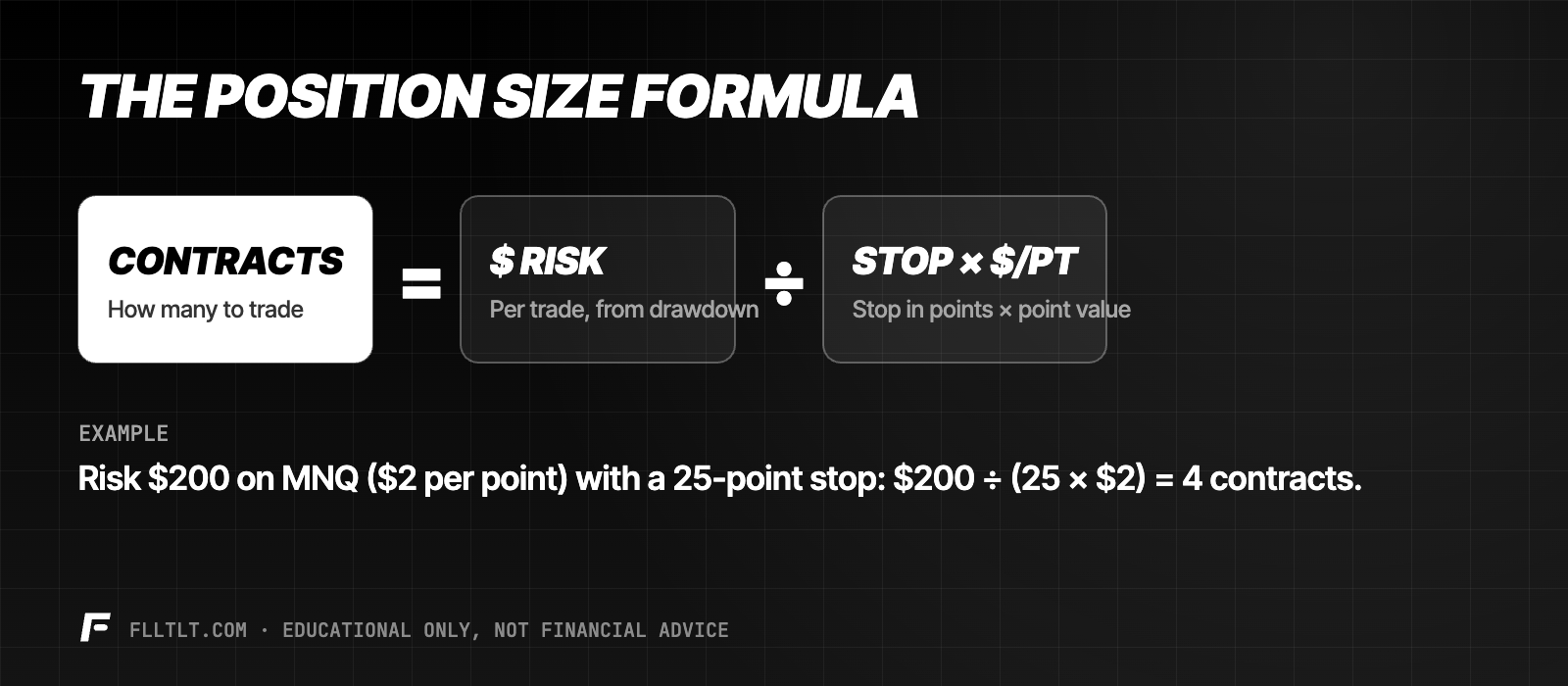
If the formula gives you 2.6 contracts, round down to 2. If it gives you less than 1, the stop is too wide for your risk: skip the trade, use a smaller contract, or find a tighter setup.
What are common futures point values?
| Contract | Tick size | Tick value | Point value |
|---|---|---|---|
| ES (E-mini S&P 500) | 0.25 | $12.50 | $50 |
| MES (Micro E-mini S&P 500) | 0.25 | $1.25 | $5 |
| NQ (E-mini Nasdaq-100) | 0.25 | $5.00 | $20 |
| MNQ (Micro E-mini Nasdaq-100) | 0.25 | $0.50 | $2 |
| CL (Crude Oil) | 0.01 | $10.00 | $1,000 |
| GC (Gold) | 0.10 | $10.00 | $100 |
Micro contracts are one tenth of their E-mini versions, which is why they're so useful in evaluations: they let you size precisely.
Where should your stop go?
Where the trade idea is proven wrong, not where the dollar amount runs out. Put the stop beyond the level that invalidates the setup, then reduce contracts until the dollar risk fits your rule. A stop placed just to fit a dollar number tends to get hit by normal market noise.
What win rate do you need?
It depends on your average win versus your average loss. Measured in R, where 1R is your risk per trade:
| Average win | Break-even win rate |
|---|---|
| 1R | 50% |
| 1.5R | 40% |
| 2R | 33% |
| 3R | 25% |
Expectancy = (win rate × average win) − (loss rate × average loss). Win 45% of the time with 2R winners and 1R losers, and each trade earns 0.45 × 2 − 0.55 × 1 = 0.35R on average. That's an edge, even though you lose more often than you win.
How do daily limits work?
Set a daily loss limit of 20–25% of your drawdown, and stop trading when you hit it. Many traders also cap trades per day, for example three, and stop after two losses in a row. These limits matter most on the days you least want them.
Can two trades be one risk?
Yes. ES and NQ often move together, so being long both is close to one bigger long. The same goes for copying the same trade across several funded accounts: one bad trade hits all of them at once. Size correlated positions as a single risk.
From the desk Indy trades MNQ and records results in points on Day Trader Income. Points make sizing simple: decide the stop in points from the chart, then the contract count is just your dollar risk divided by stop points times $2.
Common risk mistakes
- Moving the stop further away. The trade was wrong. Moving the stop just makes the loss bigger.
- Adding to losers. Averaging down in a drawdown-limited account turns one bad trade into a failed one.
- Sizing up after a win. Confidence is not a risk rule.
- Trading without a stop. If you can't define the risk, you can't size the trade.
Go deeper
- How much should you risk per trade?
- Position sizing for futures, step by step
- Trading on tilt: the trading psychology guide
- Prop firm daily loss limits, explained
- Tick value and point value in futures
- Your first week as a funded trader
The bottom line
Risk management isn't a mood, it's math you do before every trade: fixed dollar risk, a stop that means something, and contracts that fit. Get that right and the rest of trading gets a lot quieter. Next, see how to pass a prop firm evaluation and why most traders fail.
FAQ
How much should I risk per trade in a prop firm account?
A common guideline is 5–10% of the maximum drawdown per trade. On a $2,000 drawdown that is $100–$200, so it takes 10 to 20 losses in a row to fail.
What is a good risk-reward ratio?
There is no single right ratio. What matters is that your win rate and average reward together are positive. At 1:2 you break even at a 33% win rate; at 1:1 you need more than 50%.
Should I use a stop loss in a prop firm account?
Yes. A stop defines your risk before you enter, which is the only way to size a position correctly. Trading without one in a drawdown-limited account is how single trades end evaluations.
Is trading ES and NQ at the same time double the risk?
Often, yes. The two indexes usually move together, so a long in each behaves much like one larger position. Size them as if they were one trade.
What is risk of ruin?
Risk of ruin is the chance that a run of losses wipes out your account, or in prop trading, hits the drawdown. It rises fast as risk per trade goes up, which is why small, fixed risk matters so much.