Why Most Traders Fail Prop Firm Evaluations
Most traders fail prop firm evaluations because of risk, not strategy. The five patterns behind blown accounts, and the fixes that work.
On this page

The short answer: Most traders fail prop firm evaluations because of risk, not strategy. They size too big trying to hit the target fast, one or two losses take a big bite of the drawdown, and the urge to win it back finishes the job. The fix is boring and it works: smaller size, daily limits and a plan you don't change mid-account.
Key takeaways
- Most failed accounts follow the same loop: size up, big loss, revenge trade, fail.
- Strategy matters less than sizing and rule-following in an evaluation.
- A personal daily loss limit is the circuit breaker most traders skip.
- A reset bought on tilt usually fails faster than the first account.
What does the failure loop look like?
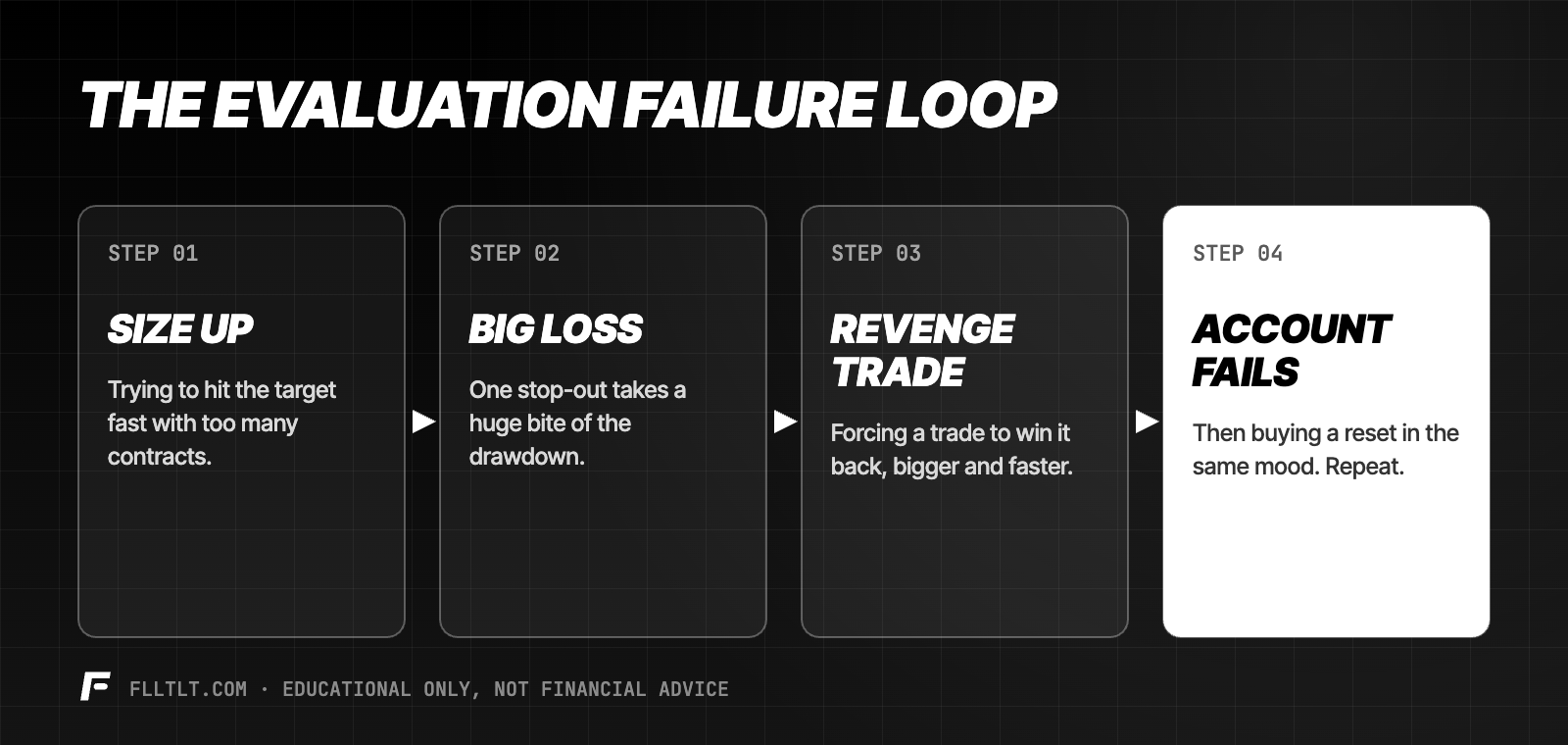
Almost every blown evaluation runs through these four steps. Break any one link and the loop stops.
Why do traders really fail?
1. They size for the target, not the drawdown
A $3,000 target feels far away, so traders trade more contracts to get there faster. But the account can only lose $2,000. Risk $500 a trade and four losers in a row end it. Risk $150 and it takes fourteen. Read how to pass a prop firm evaluation for the sizing table.
2. They don't understand their drawdown
On an intraday trailing drawdown, a trade that runs up and comes back costs cushion even if it closes green. Traders who don't know their drawdown type fail at balances they thought were safe. See trailing drawdown, explained.
3. They revenge trade
One red trade turns into three, each bigger and faster than the last. This is tilt, and it's the reason the name Fulltilt is a joke and a warning at the same time.
4. They have no daily stop
Without a personal daily loss limit, one bad morning can take the whole drawdown. With a limit of 20–25% of the drawdown, it takes four or five bad days to fail, which gives you time to notice and fix what's wrong.
5. They change the plan mid-account
New indicator on Monday, new market on Wednesday, new size on Friday. An evaluation tests whether one plan works under rules. Changing it every few days means nothing is being tested.
From the desk Indy keeps a rules-only public record in points on Day Trader Income. The point of a rules-only record is the same as the point of an evaluation: proving a fixed plan works, not hoping the next change will.
How do you stop failing?
- Risk 5–10% of the drawdown per trade. Write the dollar amount on a sticky note.
- Set a daily loss limit and a daily profit cap. The cap protects you from consistency rules and overconfidence.
- Trade one market and one setup for the whole evaluation.
- Stop after two losses in a row and review before the next trade, or before tomorrow.
- Paper trade the plan first. If it doesn't work in a simulator, an evaluation won't fix it.
- Decide your reset rule before you start. For example: no new account until you've journaled why the last one failed.
The bottom line
Evaluations are risk tests, and most traders fail them by risking too much and then trying to win it back. Size from the drawdown, use daily limits, and keep the plan fixed. For the full picture, read the complete guide to prop firm trading.
FAQ
What percentage of traders pass prop firm evaluations?
Firms rarely publish complete pass rates, and the numbers that are published vary by firm and program. What is clear across the industry is that most traders do not pass, and fewer still reach consistent payouts.
What is the number one reason traders fail evaluations?
Oversizing. Risking too much per trade lets a small losing streak hit the maximum drawdown before the profit target is reached.
Should I buy another evaluation after failing?
Only after you can name exactly why the last one failed and what you changed. Buying a new account in the same frame of mind usually repeats the same result.
Is it better to start with a smaller account?
Often, yes. Smaller accounts cost less, and the skill being tested is the same: following risk rules. Pick the size whose drawdown fits your stop sizes.