How to Pass a Prop Firm Evaluation
The rules, the math and a simple plan for passing a prop firm evaluation, with trailing drawdown and consistency rules explained in real numbers.
On this page

The short answer: To pass a prop firm evaluation, size every trade from the maximum drawdown, not the profit target, and trade a simple plan for as many days as it takes. Most accounts don't fail because the trader can't find winners. They fail because a few oversized losses hit the drawdown before the target is reached.
Key takeaways
- The drawdown is the real limit. The profit target is just the finish line.
- Risk 5–10% of the drawdown per trade, so one bad day can't end the account.
- Set your own daily loss limit, tighter than the firm's.
- Know the consistency rule before day one, or a great day can delay your pass.
- Passing usually takes weeks. Plan for that.
Which rules decide whether you pass?
Five rules decide almost every evaluation. Read each one in your firm's rulebook before your first trade.
| Rule | What to check | Why it matters |
|---|---|---|
| Profit target | The amount, and any minimum trading days | Sets how far you need to go |
| Maximum drawdown | Static, end-of-day trailing or intraday trailing; where it stops trailing | The rule that fails the most accounts |
| Daily loss limit | Whether there is one, and whether breaking it fails or pauses the account | Can end an account on one bad morning |
| Consistency rule | The maximum share of profit allowed from one day | Can delay a pass after a big day |
| Position size | Max contracts, and whether it scales with profit | Limits how fast you can lose, and win |
How does a trailing drawdown work?
A trailing drawdown follows your account's highest balance, so profits raise your failure line. Start a 50K account with a $2,000 end-of-day trailing drawdown and your failure line is $48,000. Close a day at $51,500, and the line moves up to $49,500. It never moves back down.
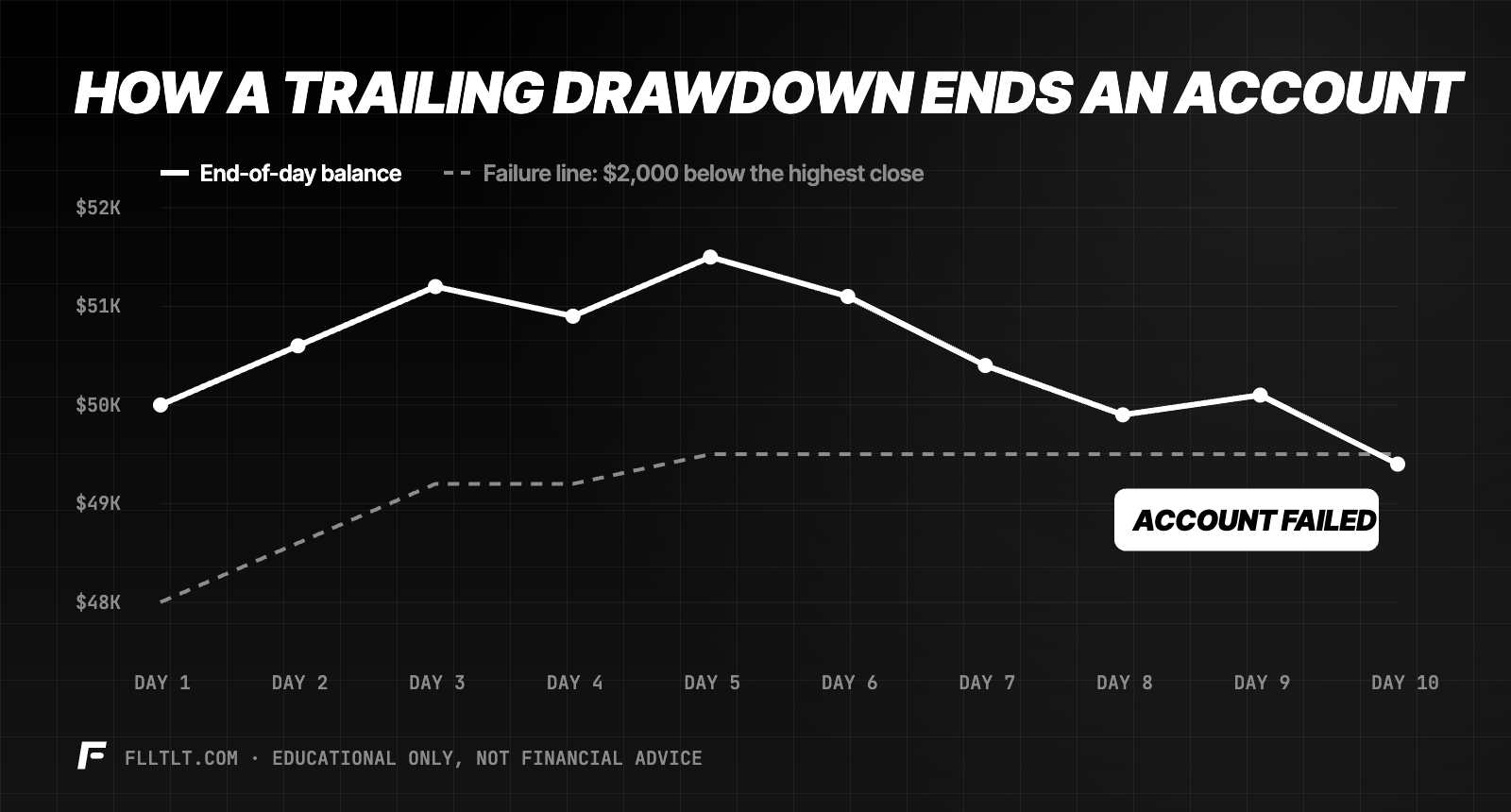
In the example above, the trader was up $1,500 on day 5 and still failed on day 10 with the account at $49,400, because the line had climbed to $49,500. Many firms stop trailing once the line reaches the starting balance, which is why the first goal is to build a cushion.
- End-of-day trailing only moves when the day closes. Open profits during the day don't raise the line.
- Intraday trailing moves with every new high, even mid-trade. A trade that goes $800 your way and comes back can cost you $800 of cushion without a single loss.
- Static drawdowns never move. They're the most forgiving and the least common.
How much should you risk per trade?
Risk 5–10% of the drawdown per trade. On a $2,000 drawdown that's $100–$200, so it takes 10 to 20 losers in a row to fail.
| Risk per trade | Losers in a row to fail ($2,000 drawdown) | MNQ stop with 2 contracts |
|---|---|---|
| $100 | 20 | 25 points |
| $200 | 10 | 50 points |
| $400 | 5 | 100 points |
| $1,000 | 2 | 250 points |
MNQ (Micro Nasdaq) is worth $2 per point per contract. If your setup needs a 50-point stop, two contracts risk $200. Want to trade four? Your stop has to be 25 points, or your risk doubles.
Should you set your own daily loss limit?
Yes, and make it tighter than the firm's. A personal limit of 20–25% of the drawdown, $400–$500 on a $2,000 drawdown, means it takes four or five bad days to fail instead of one. When you hit it, you're done for the day. No "one more trade".
How does the consistency rule work?
A consistency rule caps how much of your total profit can come from your best day. With a 40% rule, no single day can be more than 40% of your total profit when you pass or request a payout.
- Best day $1,200 on a $3,000 target: 40% exactly. You pass at $3,000.
- Best day $1,500: you need $3,750 total ($1,500 ÷ 0.40) before the rule is satisfied.
- Best day $2,000: you need $5,000 total.
The fix is simple: cap your daily profit near your rule's limit. A great day you can't use is just extra risk.
What's a simple plan to pass?
- Read the rulebook. Drawdown type, daily limit, consistency, contract limits, news rules, required closing times.
- Prove it on paper first. Trade your plan in a simulator until your results hold up for several weeks.
- Size from the drawdown. Pick a fixed risk per trade (5–10% of drawdown) and never change it mid-evaluation.
- Set daily limits. A loss limit to protect the account, and a profit cap to respect consistency.
- Trade one market and one setup. Fewer decisions, fewer mistakes.
- Build the cushion first. Early profits move you away from the failure line. Protect them.
- Journal every trade. Write the setup, the risk and the result, in points or dollars, the same way every time.
From the desk Indy trades MNQ and keeps his public record in points on Day Trader Income. Tracking points rather than dollars keeps the focus on whether the plan works, which is exactly what an evaluation is testing.
Common mistakes that fail evaluations
- Sizing for the target. Trying to make $3,000 in two days means risking enough to lose $2,000 in one.
- Not knowing the drawdown type. Intraday trailing turns winning trades that reverse into lost cushion.
- Revenge trading. The fastest way to turn a red day into a failed account.
- Trading big news without a plan. Volatility spikes can blow through stops.
- Ignoring the consistency rule. Then wondering why you haven't passed at $3,400.
- Buying resets on tilt. Same trader, same mood, same result.
The bottom line
Passing an evaluation is a risk management test with a profit target attached. Size from the drawdown, set daily limits, respect the consistency rule, and give it the time it takes. For the bigger picture, read the complete guide to prop firm trading and how prop firms make money.
Go deeper
- Trailing drawdown, explained with examples: static vs end-of-day vs intraday
- Why most traders fail prop firm evaluations
- Risk management for funded traders: the position size formula and point values
- How much should you risk per trade?
- Position sizing for futures, step by step
- Trading on tilt: the trading psychology guide
- Prop firm daily loss limits, explained
- Revenge trading: why it happens and how to stop
- Prop firm consistency rules, explained
- Paper trading on TradingView
- Your first week as a funded trader
- Overtrading: how to spot it and stop it
- Day trading strategies for futures: the complete guide
- What is a funded trading account?
- What is a scaling plan?
- What is a reset?
- Futures market hours
FAQ
How long does it take to pass a prop firm evaluation?
It depends on the firm and on you. Many futures firms have no time limit but require a minimum number of trading days. Traders who pass usually take weeks, not days, because they size small enough to survive bad days.
Can you pass a prop firm evaluation in one day?
Some firms allow it, but consistency rules and minimum trading days often block a one-day pass. Even where it is allowed, the size needed to make the whole target in one day is usually big enough to fail the account in one trade.
What happens if I break a rule during an evaluation?
Breaking a hard rule like the maximum drawdown usually fails the account immediately. Softer rules, like a consistency rule, may just delay your pass until your numbers line up. Check your firm's rulebook for which is which.
Should I trade micros or minis in an evaluation?
Micros let you size much more precisely. One MNQ contract is a tenth of an NQ contract, so you can trade the same setup with risk that actually fits your drawdown.
Is it worth paying for a reset?
Only if you know why the account failed and you have changed something. A reset bought right after an angry loss usually fails the same way.