Day Trading Strategies for Futures: The Complete Guide
The core day trading strategies for futures, what makes a strategy complete, how to choose one and how to test it before you risk money.
On this page

The short answer: The most widely used day trading strategies for futures are opening range breakouts, VWAP pullbacks, support and resistance trades and trend pullbacks to a moving average. None of them works every day. What makes any strategy work is a clear setup, a stop placed where the idea is wrong, size that fits your account and the discipline to only take the trades you planned. Pick one, practice it on a simulator and track the results before you trade it with real money or in a prop firm evaluation.
Key takeaways
- A strategy is a setup, an entry, a stop, a target and a size rule. Missing one means it isn't a strategy yet.
- Different strategies suit different days: breakouts like trends, levels like ranges.
- Risk management matters more than which strategy you pick.
- Master one strategy before adding a second.
- Nothing here is a guaranteed edge. Test it yourself.
What makes a day trading strategy?
Five parts, all decided before you click.
- Setup: the market condition you're waiting for.
- Entry: the exact trigger.
- Stop: where the trade idea is proven wrong.
- Target: where you take profit, or how you trail.
- Size: how many contracts, from your risk per trade and the stop distance.
If you can't write all five down in a sentence each, you're trading a feeling, not a strategy.
What are the main day trading strategies?
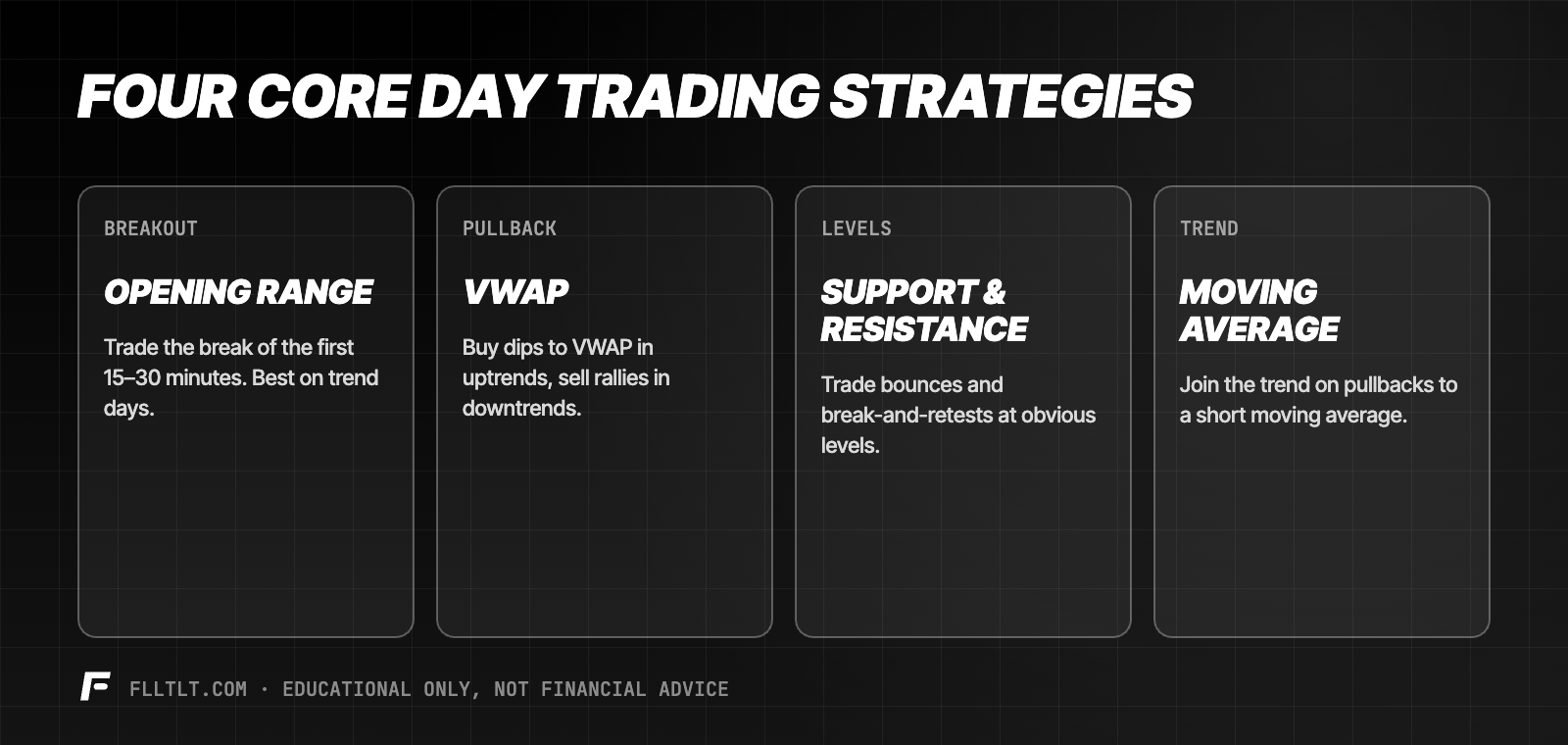
| Strategy | Best conditions | Typical stop | Common mistake |
|---|---|---|---|
| Opening range breakout | Trend days with a clean open | Range midpoint or far side | Re-entering after a false break |
| VWAP pullback | Steady trend above or below VWAP | Beyond VWAP or the pullback low | Trading it on choppy days |
| Support & resistance | Ranges, and breakouts from them | A few ticks beyond the zone | Drawing too many lines |
| Moving average pullback | Clear trends | Beyond the pullback swing | Using it in sideways markets |
Opening range breakout
Mark the high and low of the first 15 or 30 minutes, then trade the side that breaks. It's simple, mechanical and easy to define, which makes it a common first strategy. It struggles on choppy days. Full breakdown: opening range breakout, explained.
VWAP pullback
Use VWAP to judge who's in control of the day, then join the trend on a pullback to it. It keeps you trading with the day's direction and gives a logical stop. Full breakdown: VWAP trading strategy.
Support and resistance
Trade bounces at obvious levels, or the retest after a level breaks. Levels are the base layer most other strategies use, so they're worth learning first. Full breakdown: support and resistance.
Moving average trend pullback
In a clear trend, wait for price to pull back to a short moving average, like the 9 or 20-period, and enter when it resumes. It's a timing tool for trends. In sideways markets, price crosses the average constantly and the setup falls apart. Full breakdown: moving average pullback strategy.
How do you choose a day trading strategy?
Pick the one that fits your schedule, your personality and your account.
- Only free at the open? Opening range breakouts happen early.
- Patient? VWAP and level pullbacks reward waiting.
- Small account or tight drawdown? Choose setups with tighter, well-defined stops and trade micro contracts.
- Hate ambiguity? Breakouts are the most mechanical.
Then stick with it long enough to learn it: at least 20 to 30 trades on a simulator before you judge it.
How do you test a strategy before risking money?
- Write the rules down. All five parts.
- Review past charts. Find every setup in the last month and note what would have happened, including the losers.
- Paper trade it live. See paper trading on TradingView.
- Track results honestly. Win rate, average win, average loss and rule breaks.
- Only then go live, small, or in an evaluation.
Which strategies work best for prop firm evaluations?
The ones with defined, tight risk that you can repeat every day. Evaluations punish big losing days and oversized winners. A strategy with a clear stop, one or two attempts per day and steady size fits the rules well. Pair it with the habits in how to pass a prop firm evaluation and risk management for funded traders.
From the desk Indy trades MNQ and publishes a rules-based record in points on Day Trader Income. The strategy matters less than people think. The record comes from doing the same planned thing every day and stopping when the plan says stop.
Is there a best day trading strategy?
No. Every strategy has good days and bad days. Anyone selling a strategy that "always works" is selling something else. The best strategy is the one you understand, have tested and can follow with discipline when you're down on the day. That last part is where most traders struggle. See trading on tilt.
Go deeper
- Opening range breakout strategy, explained
- VWAP trading strategy
- Support and resistance
- Position sizing for futures
- Overtrading: how to spot it and stop it
- Moving average pullback strategy
- How to read candlestick charts
- Futures market hours
The bottom line
Breakouts, VWAP, levels and trend pullbacks cover most of what day traders actually do. Learn one, define all five parts, test it on a simulator and size it for your account. A plain strategy traded with discipline beats a clever one traded on emotion.
FAQ
What is the best day trading strategy?
There is no single best strategy. Common ones include opening range breakouts, VWAP pullbacks, support and resistance and moving average pullbacks. The best one is the one you have tested and can follow with discipline.
What day trading strategy is best for beginners?
Many beginners start with a simple, mechanical setup like the opening range breakout or support and resistance, practiced on a simulator before using real money.
What are the parts of a trading strategy?
A complete strategy defines the setup, entry trigger, stop, target and position size, all decided before the trade.
Which strategies work for prop firm evaluations?
Strategies with clear, tight stops that can be repeated daily at steady size tend to fit evaluation rules best, since evaluations punish large losing days.
How long should I test a strategy?
Track at least 20 to 30 trades on a simulator, including losers, before judging whether it works for you.