Overtrading: How to Spot It and Stop It
More trades usually means less money. Here is what overtrading is, what causes it, how to spot it in your journal and how to stop.
On this page
The short answer: Overtrading is taking more trades than your plan calls for, usually low-quality trades taken out of boredom, frustration or the urge to make the day "worth it." Each extra trade adds commissions and risk while diluting your best setups. Stop it with a written list of setups, a maximum number of trades per session and a rule to walk away when you hit either your daily stop or your daily goal.
Key takeaways
- Overtrading means trades outside your plan, not just "a lot" of trades.
- Low-quality trades drag down the results of your good ones.
- Boredom, a slow market and a daily dollar goal are common causes.
- A trade cap per session is the simplest fix.
- In a prop firm account, extra trades are extra chances to hit a limit.
What is overtrading?
Taking trades your plan doesn't call for. A scalper who takes 30 planned trades a day isn't overtrading. A swing trader who takes three unplanned trades is. The number matters less than whether each trade matches a setup you defined before the session.
Why is overtrading so costly?
Because bad trades eat good ones. Most traders have a few setups that make money over time and a lot of "maybe" trades that don't. Every maybe trade takes a bite out of what the good ones earned.
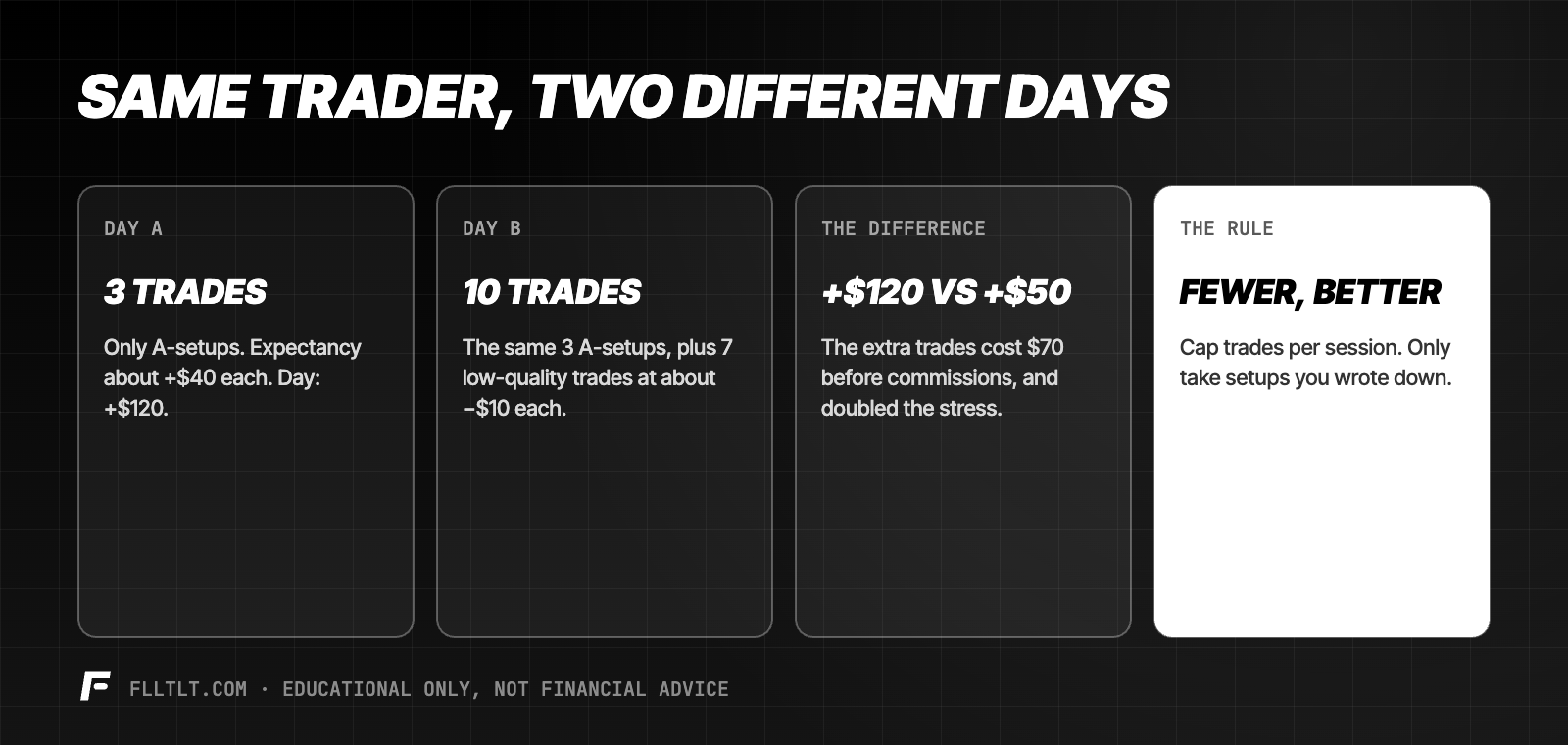
On Day B the trader did more work, took more risk and made less money, before commissions. Over a month, that gap is the difference between a funded account and a failed one.
What causes overtrading?
- Boredom. Slow markets make waiting feel like doing nothing. It isn't. Waiting is the job.
- A daily dollar goal. "I need $300 today" turns every quiet hour into pressure to force something.
- Chasing a loss. Extra trades after a loss are often revenge trading in disguise.
- Chasing a win. After a great trade, everything starts to look like a setup.
- Screen time. The longer you watch, the more trades you find. Most of them aren't real.
How do you know you're overtrading?
Check your journal for three things.
- Trades with no named setup. If you can't say which setup it was, it was a guess.
- Results by trade number. Many traders find their first two or three trades of the day carry their profit, and later trades give it back.
- Results by time of day. Midday chop is where a lot of overtrading lives.
How do you stop overtrading?
Make the decision before the session, so you're not making it trade by trade.
- Write down your setups. One to three, with clear entry conditions. If it's not on the list, it's not a trade.
- Cap trades per session. Pick a number based on your journal, such as three or five. When you hit it, you're done.
- Trade a set window. Many day traders focus on the first hour or two after the open, when moves are cleaner.
- Set a daily stop and a daily goal. Hitting either one ends the session. See daily loss limits.
- Drop the dollar target. Aim to follow the plan. The money follows the trades, not the other way around.
From the desk Indy trades MNQ and logs every trade in points on Day Trader Income. A public record is a good overtrading filter: every trade goes on the list, so each one has to be worth explaining.
Why does overtrading fail prop firm accounts?
Because every trade is another chance to hit a limit. Prop firm accounts have a drawdown, often a daily loss limit, and sometimes a consistency rule. Low-quality trades push you toward all three. Passing an evaluation usually takes fewer trades than people think, as long as each one is a good one. More in how to pass a prop firm evaluation.
The bottom line
Overtrading is the gap between the trades you planned and the trades you took. Close it with a short list of setups, a hard trade cap and a habit of walking away. Some of the best trading days are the ones where you took two trades and closed the platform.
FAQ
What is overtrading?
Overtrading is taking more trades than your plan calls for, usually low-quality trades taken out of boredom, frustration or pressure to hit a daily goal.
How many trades a day is too many?
There is no single number. It is too many when trades fall outside your written setups or when your journal shows later trades giving back earlier profits.
How do I stop overtrading?
Write down one to three setups, cap the number of trades per session, trade a set time window and stop for the day when you hit your daily stop or goal.
Is overtrading the same as revenge trading?
Not exactly. Revenge trading is trading to win back a loss. Overtrading is any trading beyond your plan, which can also come from boredom or overconfidence.
Why is overtrading bad in a prop firm account?
Each extra trade adds risk against the drawdown, daily loss limit and sometimes consistency rules, without adding much expected profit.