Trading on Tilt: The Trading Psychology Guide
What tilt is, the four signs you are on it, what triggers it, and the simple rules that stop one bad trade from becoming ten.
On this page

The short answer: Trading on tilt means making emotional decisions after a loss, a missed move or a big win, and abandoning your plan. Signs include sizing up, trading faster, moving stops and trying to win money back. The fix is mostly mechanical: hard daily limits decided in advance, a break the moment you notice it, and smaller size when you return.
Key takeaways
- Tilt is acting on emotion instead of your plan, usually right after a strong feeling.
- It shows up in behavior first: size, speed, stops and story.
- Losses trigger it most, but big wins and missed moves do too.
- Willpower doesn't fix tilt. Rules you set before the session do.
- The cost isn't one bad trade. It's the streak of bad trades that follows.
What does "tilt" mean in trading?
Tilt is when emotion takes over your decisions and your plan goes out the window. The word comes from poker, where a player "on tilt" starts playing badly after a bad beat. Poker borrowed it from pinball, where shaking the machine too hard made it lock up and flash TILT.
In trading, it looks the same. One trade goes wrong, and the next ten are about that one. You're not reading the chart anymore. You're reacting to how you feel about it.
Yes, this brand is named after it. Fulltilt is a joke every trader gets, because every trader has been there. The goal isn't to pretend you never tilt. It's to catch it faster and make it cost less.
What are the signs you're on tilt?
Watch your behavior, not your feelings. Feelings are hard to judge in the moment. Behavior is easy to spot if you know what to look for.
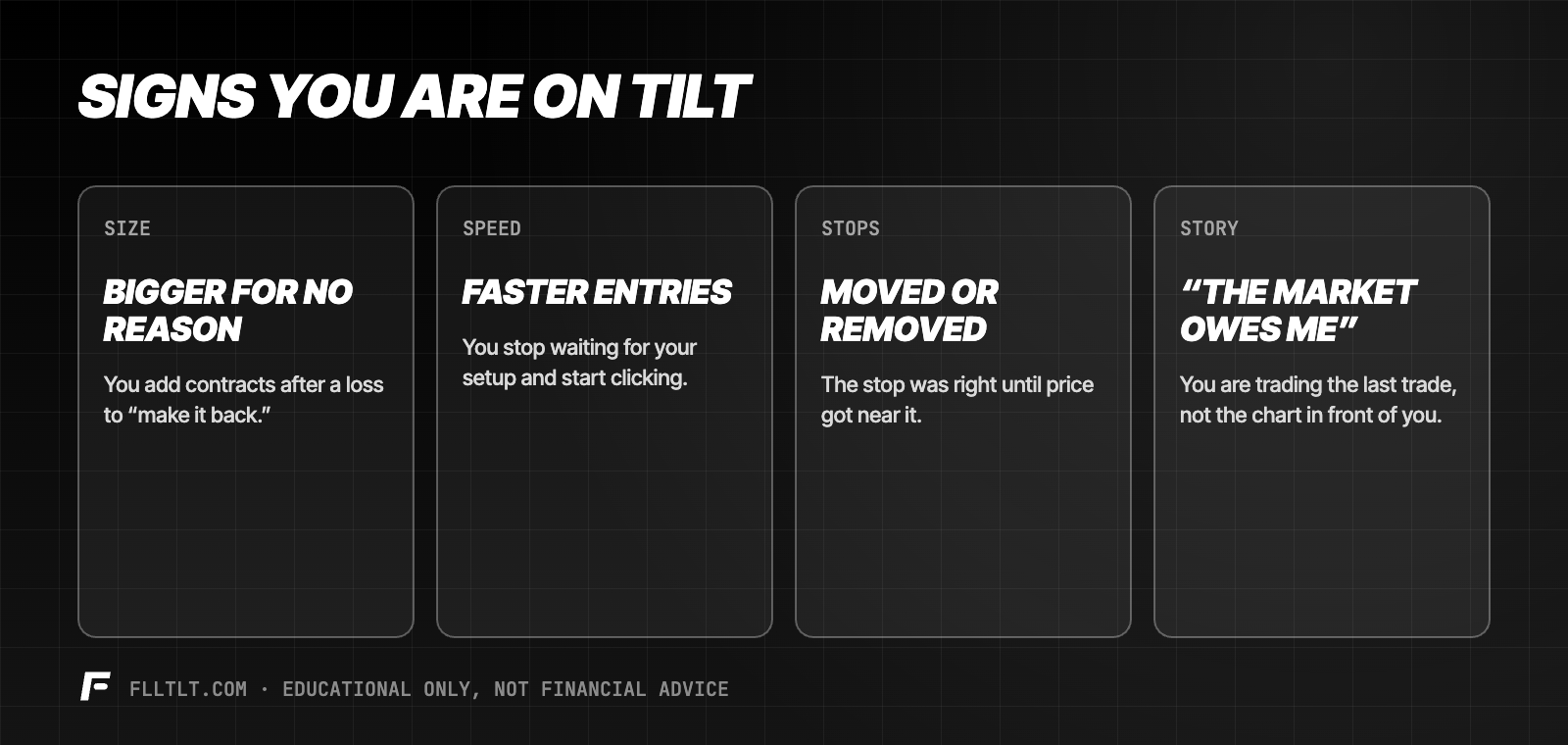
- Size: your contract count goes up after a loss, with no change in the setup.
- Speed: you take trades you wouldn't take on a calm day, or enter before the signal.
- Stops: you widen a stop, pull it, or add to a losing position.
- Story: you're thinking about getting back to even, not about this trade.
If two of those show up in the same session, you're on tilt. Treat it like a rule, not a feeling.
What causes tilt?
A strong emotional hit, followed by an urge to act on it right away. The most common triggers:
| Trigger | What it feels like | What it makes you do |
|---|---|---|
| A big loss | Anger, embarrassment | Revenge trade to win it back |
| A stop hit, then price reverses | “I was right” | Re-enter bigger with no stop |
| A missed move | Fear of missing out | Chase a late entry |
| A big win | Invincible | Size up and get careless |
| Life outside the screen | Stress, no sleep | Trade to feel in control |
The big win is the one people forget. Overconfidence after a great day leads to the same oversized, unplanned trades as anger after a bad one.
Why is tilt so expensive in a prop firm account?
Because the drawdown is small and doesn't forgive streaks. In a personal account, a tilted afternoon hurts. In an evaluation, it can end the account. One loss at normal size is fine. Three revenge trades at double size can take most of a $2,000 trailing drawdown in under an hour.
That's why tilt sits at the center of why most traders fail evaluations. The strategy usually isn't the problem. The response to a losing trade is.
How do you stop trading on tilt?
Decide the rules before the session, when you're calm, so you don't have to decide anything in the moment. Tilt wins when you're negotiating with yourself. Rules end the negotiation.
- Set a personal daily loss limit below your firm's limit. Often two or three losing trades.
- Set a maximum number of trades per session. When you hit it, you're done.
- Fix your size in advance. Use the same risk per trade every trade. No "this one's a sure thing."
- Use a bracket order. Stop and target placed at entry, so there's nothing to touch.
- Make a walk-away rule. Two losses in a row means a 15-minute break, away from the screen.
What should you do the moment you notice tilt?
Stop trading first. Figure it out second.
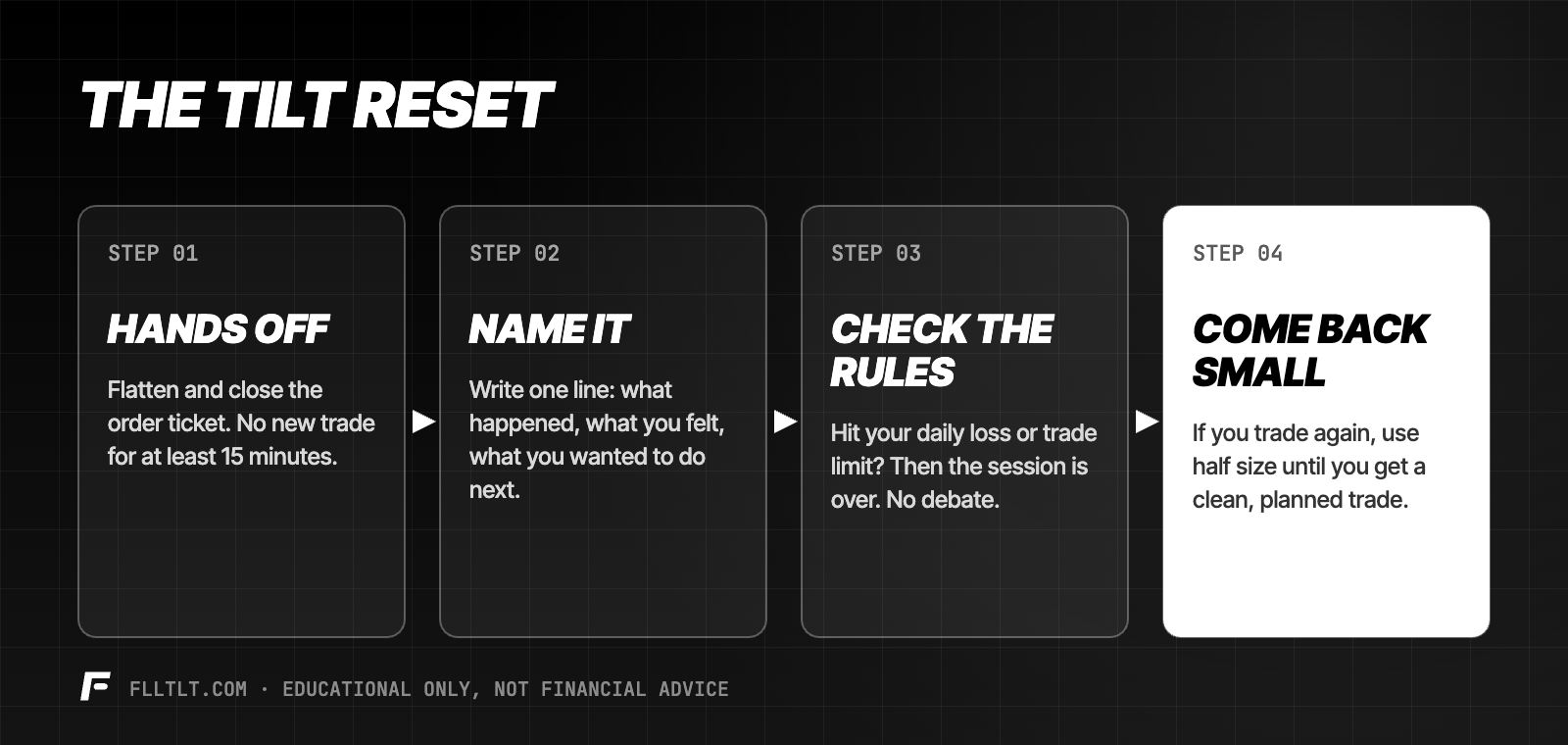
The break matters more than anything you do during it. The urge to trade again right away is the tilt talking. Fifteen minutes is usually enough for it to fade. If you've hit your daily limit, the session is over, and the fact that you want to keep going is the reason to stop.
From the desk Indy trades MNQ and posts his record in points on Day Trader Income, losses included. Publishing every trade is its own tilt check: when you know a revenge trade will be on the record, it gets a lot easier not to take it.
Does journaling help with tilt?
Yes, if you write down how you felt, not just what you traded. Most trading journals record entry, exit and P&L. Add one line for your state before the trade: calm, rushed, angry, bored. After a few weeks, patterns show up. Many traders find their worst trades cluster at the same time of day, after the same kind of loss, or on days with little sleep.
Is tilt the same as revenge trading?
Revenge trading is one kind of tilt. It's the specific urge to win back a loss right away. Tilt is broader: it also covers overconfidence after wins, chasing missed moves and trading out of boredom. If you only watch for revenge trades, you'll miss half of it.
Can you trade well with emotions at all?
Yes. The goal isn't to feel nothing. It's to not let feelings place the order. Every trader feels a loss. The ones who last have a process that keeps working while they feel it. Fixed size, fixed limits, a stop placed at entry, and a habit of stepping away. That's not cold. That's just a plan that doesn't depend on your mood.
Go deeper
- Why most traders fail prop firm evaluations
- How much should you risk per trade?
- Risk management for funded traders
- How to pass a prop firm evaluation
- Revenge trading: why it happens and how to stop
- Prop firm daily loss limits, explained
- Overtrading: how to spot it and stop it
The bottom line
Everyone tilts. The difference is whether it costs you one trade or the whole account. Set your limits while you're calm, watch for size, speed, stops and story, and walk away the moment you see it. Then come back small. That's not a pep talk. It's the plan.
This article is general education, not mental health or financial advice. If stress around trading is affecting your life outside the screen, talk to someone you trust or a qualified professional.
FAQ
What does it mean to be on tilt in trading?
Being on tilt means making emotional decisions after a strong feeling, usually a loss, and abandoning your trading plan. It often shows up as sizing up, trading faster, moving stops or trying to win money back.
Where does the term tilt come from?
It comes from poker, where a player on tilt plays badly after a bad beat. Poker borrowed it from pinball machines, which locked up and showed TILT when shaken too hard.
How do I stop revenge trading?
Set a personal daily loss limit and a maximum number of trades before the session, use bracket orders, and take a break of at least 15 minutes after two losses in a row.
Can a big win cause tilt?
Yes. Overconfidence after a big win can lead to oversized, unplanned trades just like anger after a loss does.
Why is tilt so dangerous in a prop firm evaluation?
Prop firm drawdowns are small and trailing. A few revenge trades at larger size can use up most of the drawdown in one session and fail the account.