How Much Should You Risk Per Trade?
Risk 5–10% of your drawdown, not your balance. Here is the losing-streak math that explains why, plus a simple rule for any account size.
On this page

The short answer: Risk a fixed dollar amount per trade equal to about 5–10% of your maximum drawdown, not your account balance. On a $2,000 drawdown that is $100–$200 per trade. The reason is simple: every trader hits losing streaks, and your risk per trade decides whether a streak is a bad week or the end of the account.
Key takeaways
- In a prop firm account, measure risk against the drawdown, not the balance.
- Losing streaks of 6–11 trades are normal over 100 trades, depending on win rate.
- Dividing your drawdown by 12 gives a risk size that survives a bad run.
- Decide risk in dollars before the trade, then fit contracts to the stop.
- Raise risk only after you build a cushion, and cut it after losses.
Why does risk per trade matter so much?
Because it sets how many losses you can take before you're out. Your strategy decides how often you win. Your risk per trade decides whether you're still around when the wins show up. A good strategy sized too big fails just as surely as a bad strategy.
The question isn't "how much can I make on this trade?" It's "how many of these can I lose in a row and still be trading next week?"
Should you risk a percentage of the balance or the drawdown?
The drawdown. This is the biggest mistake new prop traders make. A $50,000 evaluation sounds like a lot of money, so 1% of the balance ($500) feels conservative. But if the maximum drawdown is $2,000, a $500 loss is a quarter of everything you can lose. Four bad trades and you're done.
| Risk based on | $50K account, $2,000 drawdown | Losses to fail |
|---|---|---|
| 1% of balance | $500 per trade | 4 |
| 10% of drawdown | $200 per trade | 10 |
| 5% of drawdown | $100 per trade | 20 |
In a personal account the balance is the real limit. In a prop firm account, the drawdown is. Size against what you can actually lose.
How long are normal losing streaks?
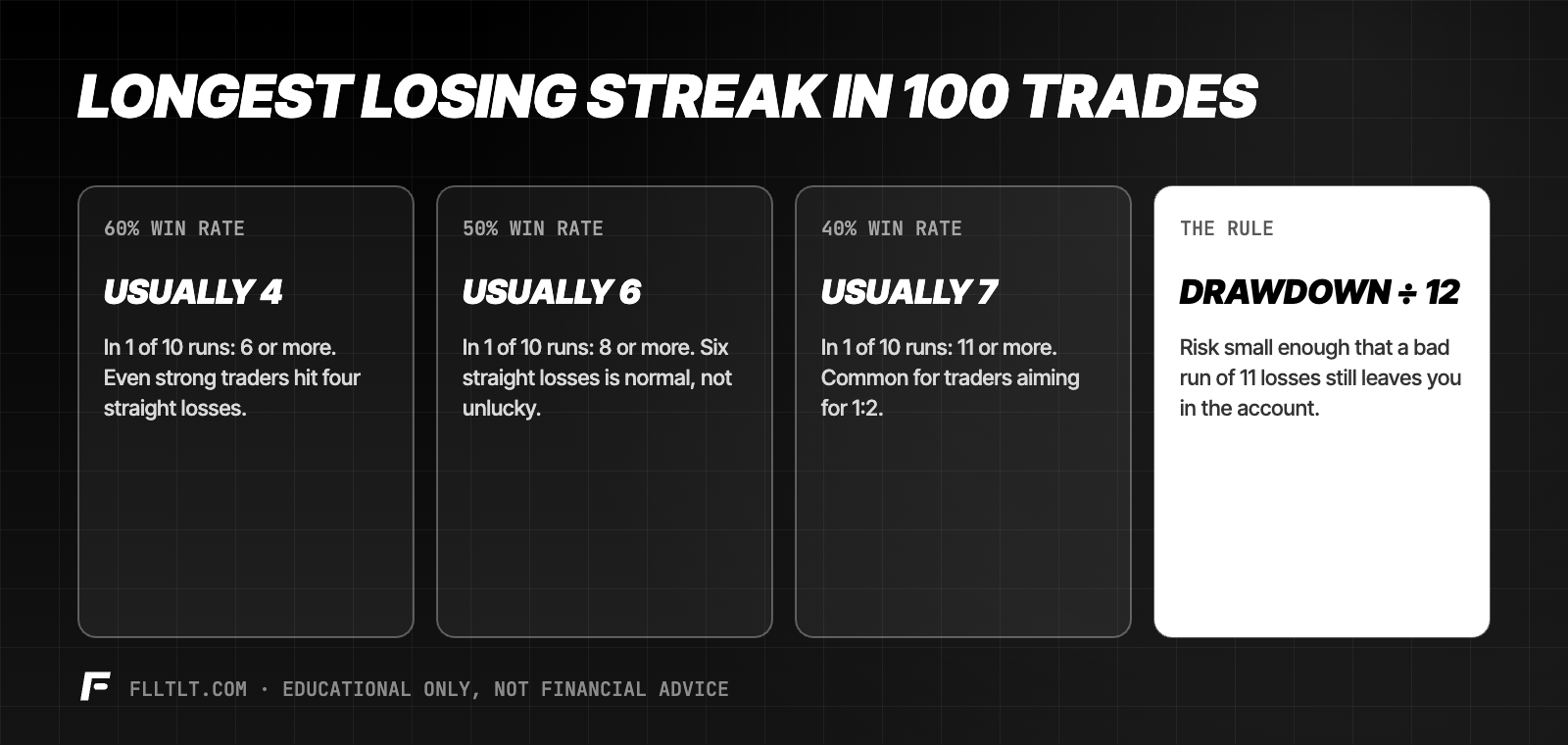
Longer than most people think. We simulated 20,000 runs of 100 trades at different win rates and recorded the longest losing streak in each run.
| Win rate | Typical longest streak | 1 in 10 runs see |
|---|---|---|
| 60% | 4 losses | 6 or more |
| 50% | 6 losses | 8 or more |
| 40% | 7 losses | 11 or more |
A 40% win rate is normal for traders who aim for twice what they risk. Those traders should expect a streak of 11 or more losses in about one of every ten 100-trade stretches. That's not bad luck. That's math.
What's a simple rule for risk per trade?
Divide your maximum drawdown by 12. That keeps a bad run of 11 losses survivable with something left over. On common account sizes:
| Max drawdown | Drawdown ÷ 12 | Rounded risk |
|---|---|---|
| $1,000 | $83 | $80 |
| $2,000 | $167 | $150 |
| $3,000 | $250 | $250 |
| $4,500 | $375 | $350 |
If your win rate is higher, you can lean toward 10% of the drawdown. If you don't know your win rate yet, use 5%. New traders almost never regret sizing too small.
Does a daily loss limit change the math?
Yes. Your risk per trade also has to fit inside the daily limit. If the firm's daily loss limit is $1,000 and you risk $250 per trade, four losses ends your day. Many traders set their own daily stop below the firm's, often two or three losing trades, so one bad session can't take a big bite out of the drawdown.
From the desk Indy trades MNQ and records results in points on Day Trader Income. Thinking in points keeps risk honest: the stop is set on the chart first, and the dollar amount follows from contracts times $2 a point. If the number is too big, the contract count drops. The stop doesn't move.
When should you increase your risk?
After you've built a cushion above your starting balance, not before. Once you're up a few multiples of your risk size, the drawdown has more room, and a slightly bigger size still survives a streak. The reverse matters too: after a string of losses, cut size. Trading bigger to win it back faster is how most evaluations fail.
- Start at 5% of the drawdown while you learn the account.
- Move toward 10% only with a cushion and a stable record.
- Drop back to 5% after three losses in a row, or after a red week.
What about risk-reward?
Risk per trade and reward-to-risk work together. At 1:2, you break even winning about 33% of the time. At 1:1 you need more than 50%. Lower win rates mean longer losing streaks, so traders who aim for bigger targets need smaller risk per trade. See the full breakdown in risk management for funded traders.
The bottom line
Pick a dollar number before the open. Make it small enough that 11 losses in a row is a lesson, not a funeral. Then turn that number into contracts with the position size formula, and don't touch it mid-session.
FAQ
How much should I risk per trade?
In a prop firm account, a common guideline is 5–10% of your maximum drawdown. Dividing the drawdown by 12 gives a size that survives a long losing streak.
Is 1% risk per trade good for a prop firm account?
1% of the account balance is usually too much in a prop firm account, because the drawdown is far smaller than the balance. On a $50,000 account with a $2,000 drawdown, 1% is a quarter of the drawdown.
How many losing trades in a row is normal?
It depends on your win rate. Over 100 trades, a 50% win rate typically produces a longest streak of about 6 losses, and a 40% win rate about 7, with 11 or more in some runs.
Should I risk more when I am winning?
Only after building a cushion above your starting balance, and in small steps. Cut size after a string of losses instead of trading bigger to recover.
Should risk per trade be a fixed dollar amount?
Yes. Decide a fixed dollar amount before the session and size contracts to fit your stop. A fixed number removes in-the-moment decisions, which is where most sizing mistakes happen.