Position Sizing for Futures, Step by Step
The four-step method to size any futures trade, with point values for ES, MES, NQ, MNQ, CL and GC, and worked examples.
On this page
The short answer: To size a futures position, divide the dollars you're willing to lose by what one contract loses at your stop. Contracts = dollar risk ÷ (stop in points × dollars per point). Always round down. If the answer is less than one, switch to the micro contract or skip the trade.
Key takeaways
- Decide dollar risk first, stop second, contract count last.
- The stop comes from the chart, never from the size you want to trade.
- Know the point value of every contract you trade.
- Round down, and add a tick or two for slippage.
- Micros (MES, MNQ, MCL, MGC) let small accounts size correctly.
How do you calculate position size for futures?
Use four steps, in this order.
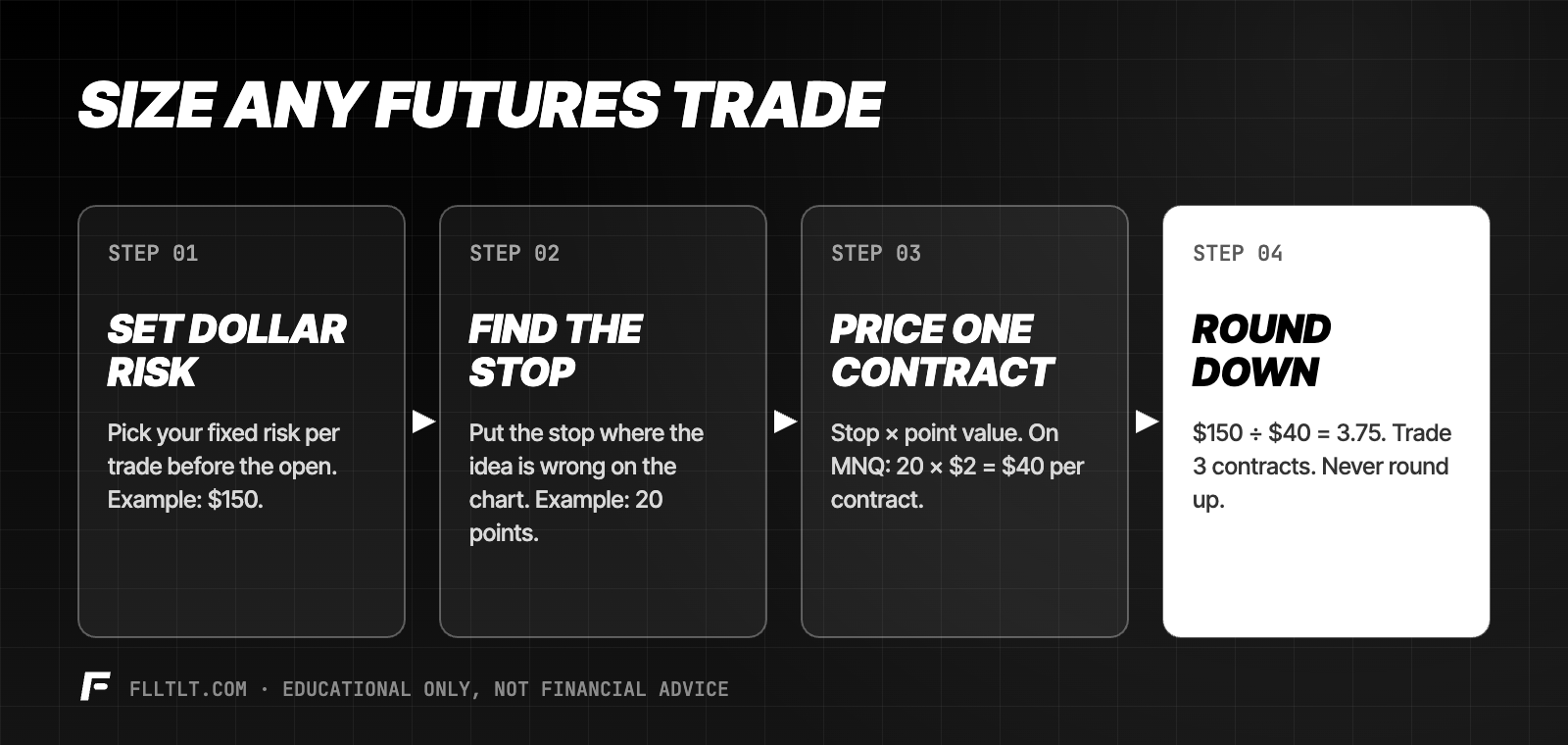
- Set your dollar risk. A fixed amount, decided before the session. If you don't have one, start with how much to risk per trade.
- Find the stop on the chart. Below the level that proves the trade wrong: a swing low, a range edge, the other side of VWAP. Measure it in points.
- Price one contract. Multiply the stop in points by the contract's dollar value per point.
- Divide and round down. Dollar risk ÷ cost per contract = how many contracts you can trade.
What are the point values of popular futures?
Each contract has a fixed dollar value per point and per tick. Check your broker's contract specs, but these are the common ones:
| Contract | $ per point | Tick size | $ per tick |
|---|---|---|---|
| ES (E-mini S&P 500) | $50 | 0.25 | $12.50 |
| MES (Micro S&P) | $5 | 0.25 | $1.25 |
| NQ (E-mini Nasdaq-100) | $20 | 0.25 | $5.00 |
| MNQ (Micro Nasdaq) | $2 | 0.25 | $0.50 |
| CL (Crude oil) | $1,000 | 0.01 | $10.00 |
| MCL (Micro crude) | $100 | 0.01 | $1.00 |
| GC (Gold) | $100 | 0.10 | $10.00 |
| MGC (Micro gold) | $10 | 0.10 | $1.00 |
What does sizing look like in real examples?
Same $150 risk, five different contracts.
| Trade | Stop | Cost per contract | $150 ÷ cost | Size |
|---|---|---|---|---|
| ES | 6 points | $300 | 0.5 | Skip (use MES) |
| MES | 6 points | $30 | 5.0 | 5 contracts |
| MNQ | 20 points | $40 | 3.75 | 3 contracts |
| MCL | 0.30 | $30 | 5.0 | 5 contracts |
| MGC | 5.0 | $50 | 3.0 | 3 contracts |
Notice what never changes: the risk. The stop is different on every chart, so the contract count changes to match. That's the whole job.
Why should you round down?
Because rounding up quietly raises your risk. On MNQ above, 4 contracts instead of 3 turns a $120 loss into $160. Do that every trade and your 5% plan becomes 7%. Rounding down keeps every loss at or under your number.
Should you add a buffer for slippage?
Yes, a tick or two, especially on fast markets. Stop orders can fill worse than the price you set, and commissions add up. Add one to two ticks to the stop distance before you divide. On MNQ with a 20-point stop, sizing off 21 points ($42 per contract) still gives 3 contracts, with some room for a bad fill.
From the desk Indy trades MNQ and records results in points on Day Trader Income. Micros are the reason that works: at $2 a point, a wide stop on a volatile day just means fewer contracts, not a bigger loss. The chart sets the stop, the math sets the size.
What if the stop is too wide to trade?
Trade the micro, or pass. If even one micro contract at your stop is more than your dollar risk, the trade doesn't fit your account today. Tightening the stop to make the size work is the classic mistake. The stop belongs where the idea is wrong. A stop moved closer just to fit more contracts gets hit by normal noise.
Do prop firms limit position size?
Yes. Most evaluation accounts cap how many contracts you can hold, and some scale the cap with your profits. The limits vary by firm and account size, so check the rules before you trade. A contract cap is a ceiling, not a target. Your size should come from the formula, and it will usually be well below the max. For how drawdowns and caps work together, read how to pass a prop firm evaluation.
The bottom line
Dollar risk, stop, cost per contract, round down. Do it before every trade and you'll never be guessing at size when the market is moving. For the bigger picture, see risk management for funded traders.
FAQ
How do you calculate position size in futures?
Divide your dollar risk by the stop distance in points times the contract value per point, then round down. For example, $150 risk on MNQ with a 20-point stop is $150 ÷ (20 × $2) = 3.75, so 3 contracts.
What is the point value of MNQ?
MNQ, the Micro E-mini Nasdaq-100, is worth $2 per point, or $0.50 per 0.25-point tick.
What is the point value of ES?
ES, the E-mini S&P 500, is worth $50 per point, or $12.50 per 0.25-point tick. The micro version, MES, is $5 per point.
Should I trade minis or micros?
Trade whichever lets you size correctly. Small accounts and tight drawdowns often need micros, because one mini contract can risk more than the whole per-trade budget.
Should I move my stop to trade more contracts?
No. The stop belongs where the trade idea is wrong. Change the number of contracts to fit the stop, not the other way around.