Prop Firm Daily Loss Limits, Explained
Hard vs soft limits, why open losses can count, when the day resets and how to set a personal daily stop that keeps you far from the line.
On this page
The short answer: A daily loss limit is the most you're allowed to lose in one trading day. Hit it and, depending on the firm, either your account fails or you're locked out until the next session. Not every firm has one, and the details vary, so check whether it's a hard or soft rule, whether open losses count and when the day resets. Then set your own limit well below it.
Key takeaways
- A daily loss limit caps one day's losses. It's separate from your maximum drawdown.
- Hard breach: the account fails. Soft breach: trading stops for the day.
- Many firms count open (unrealized) losses, not just closed trades.
- The trading day usually resets at the session close, not midnight.
- Your personal daily stop should be two or three losing trades, far below the firm's limit.
What is a daily loss limit?
It's a cap on how much you can lose in a single trading day. Your maximum drawdown protects the account over its whole life. The daily loss limit protects it from one bad session. On a $50,000 evaluation, a firm might set a $1,000 daily limit alongside a $2,000 drawdown. The exact numbers depend on the firm and the account.
Some firms have dropped daily loss limits from some plans, and others make them optional. Always read the current rules for the account you're buying.
What happens if you hit the daily loss limit?
It depends on whether the rule is hard or soft.
| Rule type | What happens | What it costs you |
|---|---|---|
| Hard breach | The account fails | The evaluation fee, or a funded account |
| Soft breach | Positions closed, trading locked until next session | The rest of that day |
A soft limit is more forgiving, but it still takes a big bite out of your drawdown. Two soft breaches in a week can use most of it.
Do open losses count toward the daily limit?
At many firms, yes. If the limit is based on unrealized P&L, a trade that's down $1,000 at its worst point can trigger the rule even if it would have come back. That's why a wide stop, or no stop, is dangerous near the limit. Your position doesn't have to close at a loss to break the rule.
Example: you're down $700 on the day with a $1,000 limit. You take one more trade with a $400 stop. If price touches $300 against you before your target, you've hit $1,000 in open losses. Depending on the firm, that's the end of the day or the account.
When does the trading day reset?
Usually at the session close, not at midnight. U.S. futures trade nearly around the clock, and most futures prop firms define the trading day by the exchange session, which closes in the late afternoon Eastern time. A loss in the evening session can count toward the next day's limit. Check your firm's exact reset time, especially if you trade overnight.
How should you set your own daily limit?
Make it a number of losing trades, not just a dollar amount, and keep it far below the firm's.
| Max drawdown | Risk per trade | Personal daily stop | Daily stop in dollars |
|---|---|---|---|
| $2,000 | $150 | 2 losses | $300 |
| $2,000 | $150 | 3 losses | $450 |
| $3,000 | $250 | 2 losses | $500 |
| $4,500 | $350 | 3 losses | $1,050 |
At two or three losses per day, a bad day costs 15–25% of the drawdown, not half. You need several bad days in a row to fail, which gives you time to notice something's wrong and fix it. To set the per-trade number, see how much to risk per trade.
From the desk Indy trades MNQ and keeps a rules-based record in points on Day Trader Income. The daily stop is the rule that makes the rest work: when it's hit, the platform closes. Not "one more look." Closed.
Why does a personal daily limit matter so much?
Because the trades you take after two losses are usually your worst. That's when revenge trading and tilt show up. A personal stop ends the session before the urge to win it back takes over. Traders who blow through daily limits rarely do it on their first loss. They do it on the fourth or fifth trade of a day that already went wrong.
Is the daily loss limit the same as the drawdown?
No. The drawdown is the account-level floor, often trailing your highest balance. The daily loss limit resets every session. You can break the daily limit without touching the drawdown, and you can fail on drawdown slowly without ever hitting a daily limit. You need a plan for both. Read how to pass a prop firm evaluation for how they fit together.
The bottom line
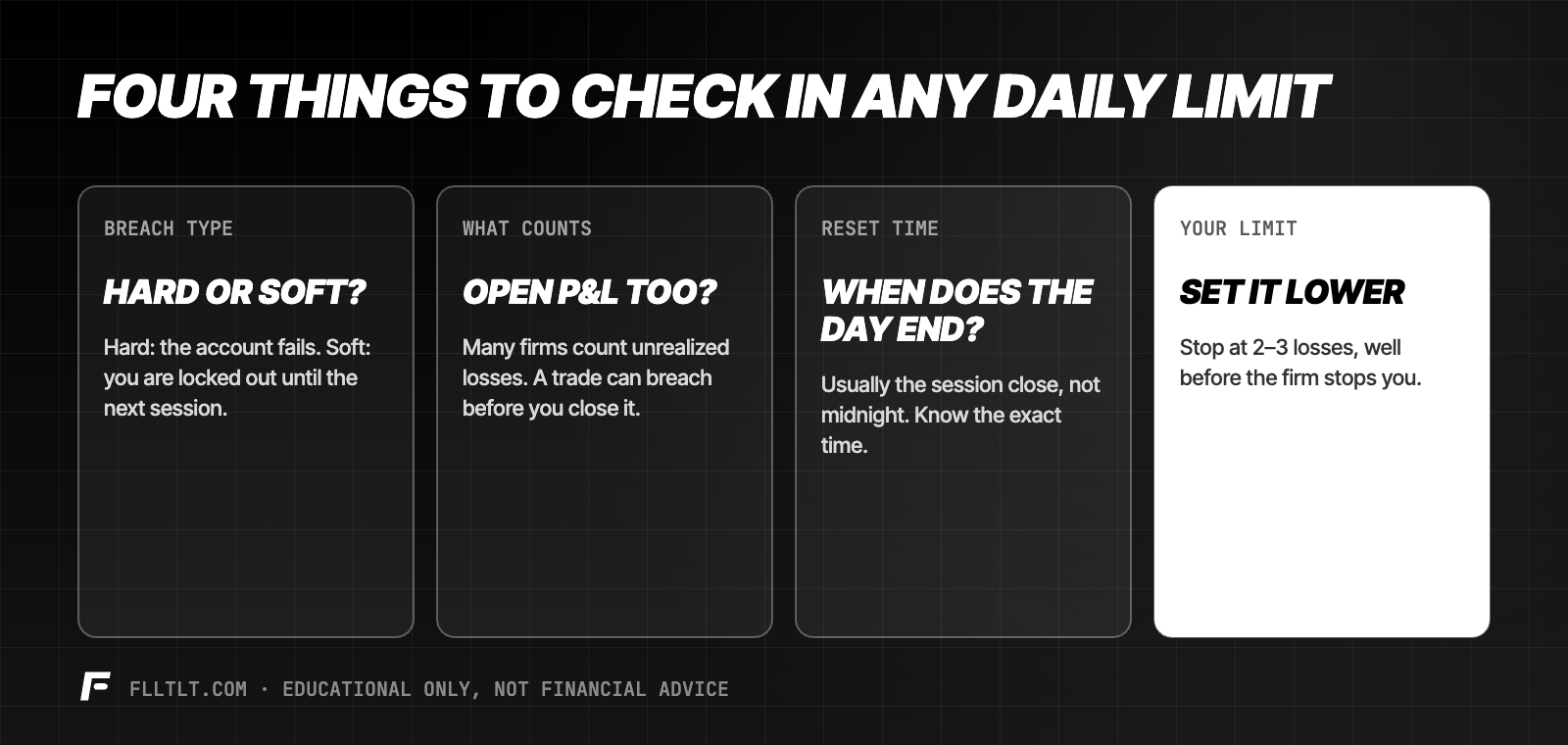
Know the four facts about your firm's daily limit: hard or soft, open or closed P&L, reset time and the dollar amount. Then set your own stop at two or three losing trades and treat it as the real rule. The firm's limit should be a line you never get close to.
FAQ
What is a daily loss limit in a prop firm?
It is the most you are allowed to lose in a single trading day. Depending on the firm, hitting it either fails the account or locks you out until the next session.
What is the difference between a hard and soft daily loss limit?
A hard breach fails the account. A soft breach closes your positions and stops trading until the next session, but the account stays active.
Does unrealized P&L count toward the daily loss limit?
At many firms, yes. If open losses count, a trade can trigger the limit before you close it, even if it would have recovered.
When does the daily loss limit reset?
Usually at the futures session close in the late afternoon Eastern time, not at midnight. Check your firm’s exact reset time.
What should my personal daily loss limit be?
A common approach is two or three losing trades at your normal risk, which keeps a bad day to roughly 15–25% of your drawdown.