Opening Range Breakout Strategy, Explained
How the opening range breakout works: marking the range, the entry trigger, stop and target placement, sizing and when it fails.
On this page
The short answer: An opening range breakout (ORB) strategy marks the high and low of the first part of the session, often the first 15 or 30 minutes after the 9:30 a.m. Eastern open, then trades in the direction price breaks out of that range. The stop usually goes back inside the range, and a common first target is one range-width beyond the breakout. It works best on trending days and struggles on choppy ones.
Key takeaways
- The opening range is the high and low of the first 15, 30 or 60 minutes.
- A close outside the range is the trigger, not just a quick poke through it.
- Stops usually go at the range midpoint or the opposite side.
- Range size sets your risk, so size contracts to fit it.
- Choppy, news-driven or holiday sessions produce lots of false breakouts.
What is the opening range?
The high and low price set in the first few minutes of the regular session. For U.S. index futures like ES and NQ, most traders use the stock market open at 9:30 a.m. Eastern, even though futures trade overnight. That's when volume jumps and the day's first real auction happens.
Common windows are 5, 15, 30 and 60 minutes. Shorter ranges trigger sooner with tighter stops but break falsely more often. Longer ranges are slower but tend to be cleaner.
How does an opening range breakout work?
Wait for the range to form, then trade the side that breaks.
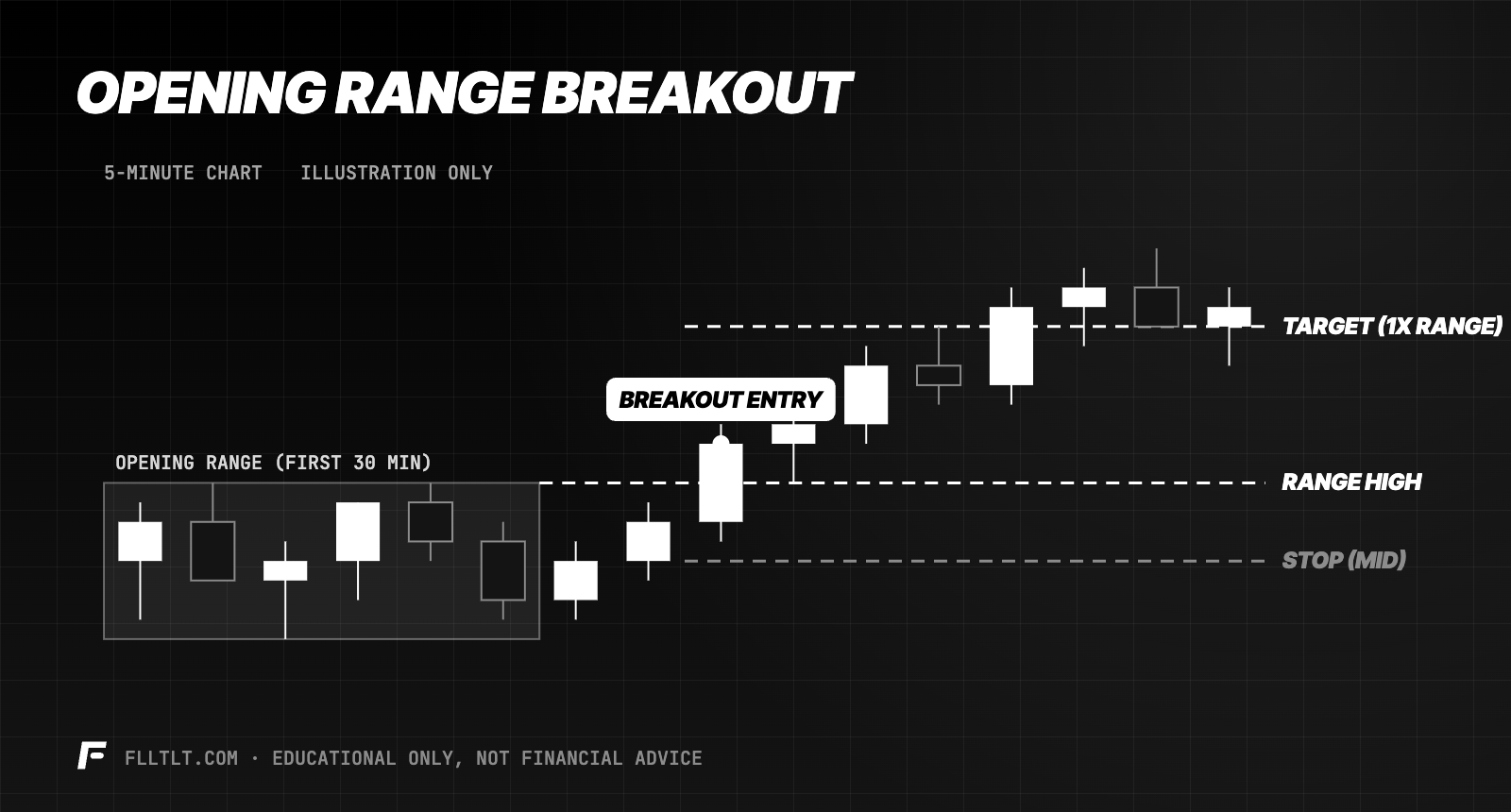
- Mark the range. Note the high and low when the window closes. In the example, 96 to 104, an 8-point range.
- Wait for a close outside it. A 5-minute candle closing above 104 is the long trigger. Below 96 is the short trigger.
- Place the stop. The midpoint (100) or the opposite side (96). The midpoint is tighter. The far side gives the trade more room.
- Set a target. A common first target is the range high plus the range height: 104 + 8 = 112.
In the example, entry is about 106 with a stop at 100, so 6 points of risk. The 112 target is 6 points away, a 1:1 trade. Many traders take part of the position off there and trail the rest.
How do you size an ORB trade?
The range sets the stop, so it sets your size. A wide opening range means a wide stop and fewer contracts. Work it out the same way as any trade: dollar risk ÷ (stop in points × point value). See position sizing for futures. If the range is so wide that even one micro contract is over your risk, skip the day.
When does the opening range breakout fail?
- Choppy days. Price breaks out, comes back in, then breaks the other way. Two stops before lunch.
- Big news days. Economic releases at 8:30 or 10:00 a.m. Eastern can whip price through both sides.
- Huge ranges. If the first 30 minutes already moved a lot, much of the day's move may be done.
- Low-volume sessions. Holidays and half days break out weakly.
A simple filter many traders use: one attempt per side, per day. If the breakout fails, you're done with the setup.
Is ORB good for prop firm accounts?
It can fit well, because the rules are clear and the risk is known before entry. Two cautions. First, false breakouts in a row eat into a daily loss limit fast, so cap yourself at one or two attempts. Second, a big winning day can trip a consistency rule, so know your daily profit cap.
From the desk Indy trades MNQ and records results in points on Day Trader Income. Thinking in points fits ORB well: the range is a number of points, the stop is a number of points, and the size follows from that.
The bottom line
The opening range breakout is one of the simplest day trading strategies to define: mark the range, wait for a close outside it, stop back inside, target one range beyond. It's not magic. It just gives you a clear plan and a known risk. Practice it on a simulator first, and read the full day trading strategies guide for how it compares to other approaches.
FAQ
What is an opening range breakout?
An opening range breakout is a strategy that marks the high and low of the first part of the trading session, then trades in the direction price breaks out of that range.
What time frame should I use for the opening range?
Common choices are the first 5, 15, 30 or 60 minutes after the 9:30 a.m. Eastern open. Shorter ranges trigger sooner but give more false breakouts.
Where do you put the stop on an opening range breakout?
Most traders place it at the range midpoint or the opposite side of the range. The midpoint is tighter; the far side gives more room.
What is a good target for an ORB trade?
A common first target is one range-width beyond the breakout level. For a range of 96 to 104, that is 112 on a long.
Why do opening range breakouts fail?
They often fail on choppy, low-volume or news-heavy days, when price breaks out and then reverses back through the range.