Moving Average Pullback Strategy for Day Traders
How to trade pullbacks to the 9 or 20 EMA in a trend: the setup, entry, stop, which average to use and when to skip it.
On this page
The short answer: A moving average pullback strategy waits for a clear trend, then enters when price pulls back to a short moving average, like the 9 or 20-period exponential moving average (EMA), and starts moving with the trend again. The stop goes beyond the pullback's swing low or high. It works well in steady trends and poorly in sideways markets, where price crosses the average back and forth.
Key takeaways
- A moving average smooths price so the trend is easier to see.
- The setup: trend first, pullback to the average second, resumption third.
- Shorter averages (9, 20) suit day trading. Longer ones (50, 200) show the bigger trend.
- The stop goes beyond the pullback swing, not on the average itself.
- Flat, tangled averages mean no trend. Skip the setup.
What is a moving average?
The average closing price over a set number of bars, updated with every new bar. A simple moving average (SMA) weights every bar equally. An exponential moving average (EMA) gives recent bars more weight, so it reacts faster. Day traders often use a 9 or 20-period EMA on a 1, 5 or 15-minute chart.
How does a moving average pullback work?
Let the trend prove itself, then buy the dip into the average.
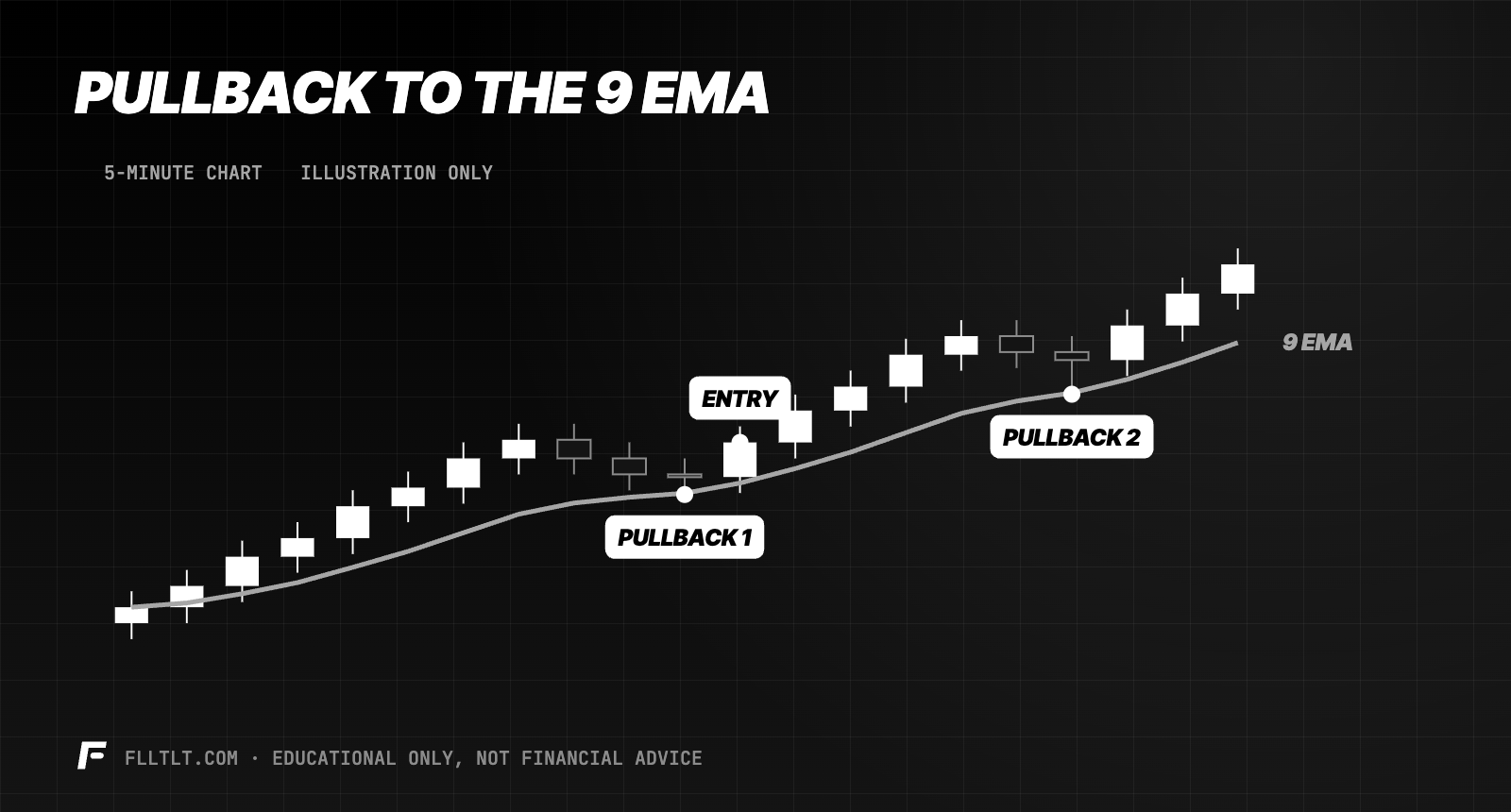
- Confirm the trend. Price is above a rising average, making higher highs and higher lows. For shorts, the opposite.
- Wait for the pullback. Price drifts back to the average. Smaller candles on the pullback are a good sign.
- Enter on the turn. A candle that closes back in the trend direction, or breaks the high of the pullback candle.
- Stop beyond the swing. Below the pullback low for longs. Size contracts to fit that distance.
- Manage the exit. Target the prior high, or trail the stop under each new higher low.
Which moving average is best?
There's no magic number. The 9 and 20-period EMAs are common for intraday trends because they hug price closely. The 50 and 200-period averages are slower and show the larger trend. Pick one and use it consistently. Switching averages after a loss is just curve-fitting.
| Average | Speed | Typical use |
|---|---|---|
| 9 EMA | Fast | Short pullbacks in strong intraday trends |
| 20 EMA | Medium | Deeper pullbacks, steadier trends |
| 50 SMA/EMA | Slow | Bigger trend direction |
| 200 SMA | Very slow | Long-term trend, mostly on daily charts |
When does the moving average pullback fail?
- Sideways markets. The average goes flat and price crosses it constantly.
- Trend exhaustion. Late in a long move, a pullback can turn into a reversal.
- Fast news moves. Price can slice through the average with no pullback structure at all.
A quick filter: if the average is flat or price has crossed it several times in the last hour, there's no trend to trade.
Moving average vs VWAP
Use them together. VWAP resets every session and shows the day's average price, weighted by volume. A short moving average follows the last few bars. Many traders use VWAP for the day's direction and a short EMA for timing entries.
From the desk Indy trades MNQ and records results in points on Day Trader Income. A short EMA and VWAP are both part of the context he watches. Neither is a signal on its own. The stop still goes where the idea is wrong, and the size comes from the points.
The bottom line
Trend first, pullback second, resumption third. The moving average just makes the trend easy to see and gives the pullback a place to land. Skip it when the average is flat, size every trade from the stop, and compare it with other approaches in the day trading strategies guide.
FAQ
What is a moving average pullback strategy?
It is a trend-following strategy that waits for price to pull back to a short moving average, such as the 9 or 20-period EMA, and enters when price resumes in the trend direction.
What is the best moving average for day trading?
There is no single best one. The 9 and 20-period EMAs are common for intraday trends. Consistency matters more than the exact number.
What is the difference between an EMA and an SMA?
A simple moving average weights every bar equally. An exponential moving average gives recent bars more weight, so it reacts faster to price changes.
Where should the stop go on a moving average pullback?
Beyond the pullback swing low for longs, or swing high for shorts, rather than exactly on the moving average.
When should I avoid moving average strategies?
In sideways markets where the average is flat and price keeps crossing it, since there is no trend to follow.