Prop Firm vs Your Own Account: Which Is Better?
Capped cost and big buying power, or full profit and full control. How prop firms and personal accounts compare on risk, rules, profit and taxes.
On this page

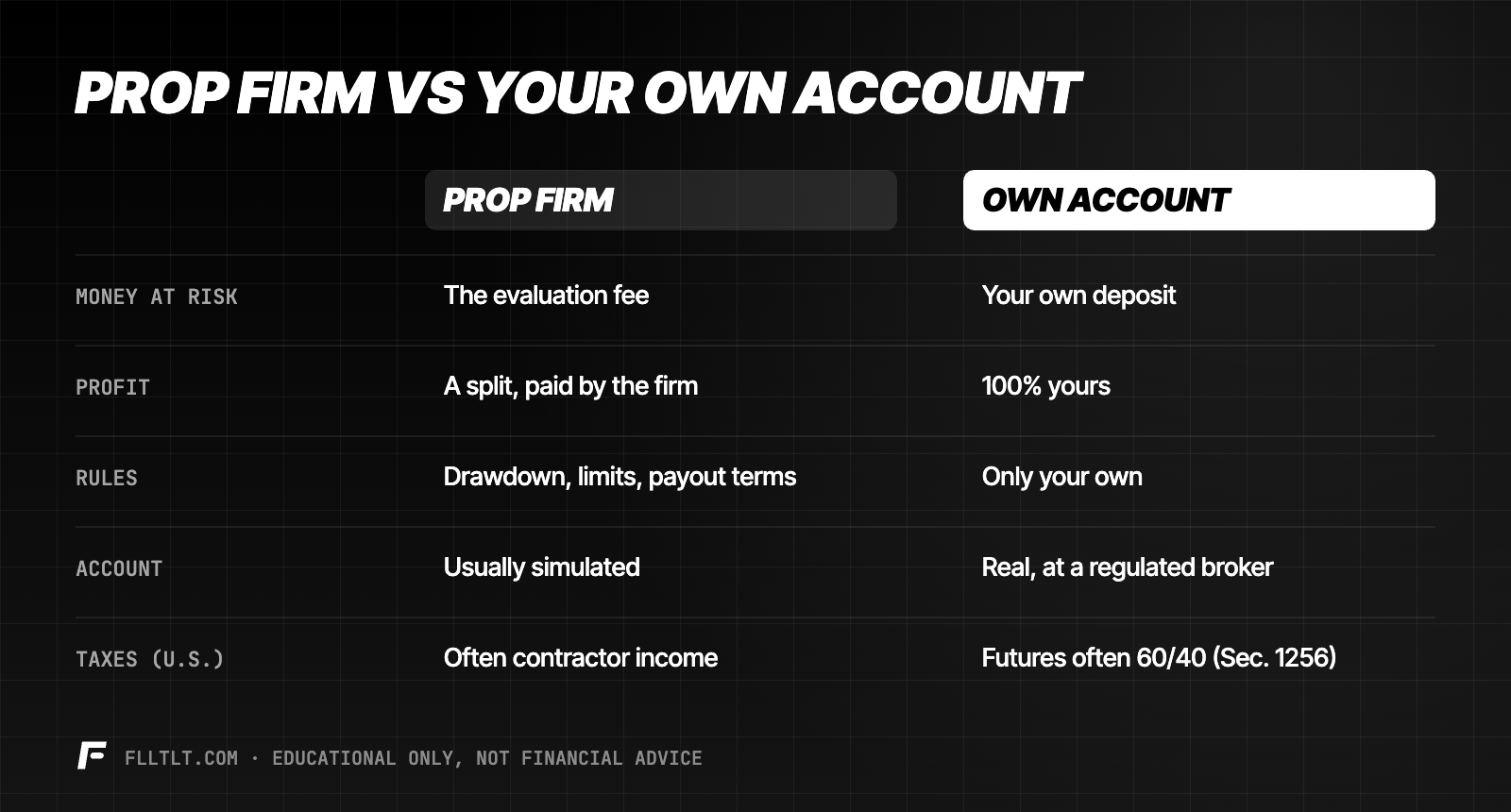
The short answer: A prop firm caps your loss at the evaluation fee and gives you access to a large account, but you trade under strict rules, share the profit and depend on the firm to pay. Your own account puts your own money at risk, but you keep all the profit, set your own rules and hold real money at a regulated broker. Prop firms suit traders with a plan and little capital. Your own account suits traders with capital and a proven record.
Key takeaways
- Prop firm: small, capped cost, big buying power, firm rules, profit split.
- Own account: your capital at risk, full profit, full control.
- Most prop funded accounts are simulated. Your own account is real money.
- U.S. tax treatment is usually different for the two.
- Many traders use both: prop for scale, a small personal account for practice and record-building.
What's the main difference?
Whose money is on the line, and who makes the rules. In a prop firm evaluation you pay a fee to trade a firm's account under its rules. In your own account you deposit money with a broker and every decision is yours.
What are the advantages of a prop firm?
- Capped downside. The most you can lose is the fee, plus any resets you buy.
- More buying power. A $50,000 or $150,000 account for a fraction of that cost.
- Built-in risk rules. The drawdown and daily loss limits force discipline, which helps some traders.
What are the disadvantages of a prop firm?
- Tight rules. Trailing drawdowns, consistency rules and contract caps can end an account that would have been fine in your own.
- Profit split and payout terms. You keep a share, on the firm's schedule, subject to its terms.
- Firm risk. Your payout depends on the firm staying in business and honoring its rules. See are prop firms legit?
- Fees add up. Repeated evaluations and resets can cost more than a small personal account.
What are the pros and cons of your own account?
Freedom and full profit, at the cost of real risk. No trailing drawdown, no consistency rule and no payout request. But a bad week costs your money, not a fee, and many new traders don't have enough capital to trade size responsibly. Micro futures like MES and MNQ help, since they let you size small while you build a record.
How are taxes different?
In the U.S., they often are, so ask a tax professional. Prop firm payouts are commonly reported as independent contractor income, because you're paid by the firm, not by the market. Gains on regulated futures in your own account generally fall under Section 1256 of the tax code, which treats 60% as long-term and 40% as short-term capital gains regardless of how long you held. Your situation may differ, and this isn't tax advice.
From the desk Indy trades MNQ futures and publishes a rules-based record in points on Day Trader Income. Points make the record portable: the same 20-point day means the same thing in a prop account or a personal one. Only the contract count changes.
Which should a new trader choose?
Neither, at first. Start with paper trading. Until you have a written plan and a few weeks of results that follow it, any money you spend is tuition. Practice on a simulator first, then decide. Our guide to paper trading on TradingView walks through it.
- Little capital, solid plan: a prop firm evaluation is a reasonable next step.
- Some capital, building a record: a small personal account on micros.
- Both: plenty of traders do exactly that.
The bottom line
A prop firm trades your capital risk for rule risk. Your own account trades rule risk for capital risk. Pick the one whose risk you can handle, and whichever you choose, the same thing decides the outcome: how you manage risk.
This is general education, not financial, legal or tax advice.
FAQ
Is it better to trade with a prop firm or your own money?
It depends on your capital and experience. Prop firms cap your loss at the fee and offer large accounts with strict rules. Your own account risks your money but gives full profit and control.
Do you keep all the profit in a prop firm?
No. Prop firms pay a profit split, and payouts follow the firm’s schedule and terms. In your own account you keep 100% of the profit.
Are prop firm accounts real money?
Many prop firm funded accounts are simulated, and the firm pays your share of profits from its own business. Your own brokerage account holds real money.
How are prop firm payouts taxed in the US?
Prop firm payouts are commonly reported as independent contractor income. Gains on regulated futures in your own account generally get Section 1256 60/40 treatment. Ask a tax professional about your situation.
Can you trade a prop firm and your own account at the same time?
Yes. Many traders use a prop firm for larger size and a small personal account for practice or a separate record.