Are Prop Firms Legit? How to Tell Before You Pay
Some prop firms are legitimate and some have vanished overnight. Here is how the model works, what has gone wrong and the checklist to use before you pay.
On this page

The short answer: Many prop firms are legitimate businesses, and some have paid traders for years. But the industry is lightly regulated, most evaluation accounts are simulated, and firms have shut down with little warning. A prop firm is legit if its rules are clear, its payouts are proven and it has a track record. Treat the evaluation fee as money you can afford to lose, and check the firm before you pay.
Key takeaways
- Evaluation prop firms sell a test, not a job. You're a customer, not an employee.
- Most funded accounts are simulated. Payouts come from the firm, not the market.
- The industry isn't regulated like brokers, so your protection is the firm's reputation.
- Some firms have closed suddenly, especially in 2024.
- Check track record, payout proof, rule clarity and support before you buy.
How do evaluation prop firms work?
You pay a fee, trade a test account under rules, and if you pass, the firm pays you a share of profits on a funded account. That's different from a traditional prop firm, which hires traders and trades its own capital.
Most evaluation firms are open about the fact that funded accounts are often simulated. Your trades may not reach a real exchange. The firm pays your profit split out of its own business, which is largely funded by evaluation fees. We break that down in how prop firms make money.
That model isn't a scam by itself. It's a product. But it means your payout depends on the firm staying healthy and honoring its own rules.
Are prop firms regulated?
Generally, not the way brokers are. Most evaluation firms say they sell an educational or assessment product, not investment services, so they don't hold the licenses a broker does. You usually don't get the protections that come with a regulated brokerage account.
Regulators have paid attention, though. In 2023, the U.S. Commodity Futures Trading Commission sued Traders Global Group, the company behind My Forex Funds, and its operations were frozen. In May 2025, a federal judge dismissed the case with prejudice and sanctioned the CFTC for misconduct in how it handled the case. Traders were stuck in the middle either way, which is the real lesson: when something goes wrong with a firm, your account can be frozen for a long time.
Have prop firms shut down?
Yes, several. In early 2024, MetaQuotes, the company behind MetaTrader 4 and 5, cut off platform licenses for a number of forex prop firms serving U.S. traders. Some firms paused, some moved to other platforms and some closed. True Forex Funds stopped operating that February and announced in May 2024 that it was closing for good, citing insolvency.
Futures prop firms run on different platforms and data feeds, so they weren't hit the same way. But the point holds for any firm: a business can change its rules, its platform or its existence, and traders find out last.
How do you tell if a prop firm is legit?
Look for evidence, not marketing.
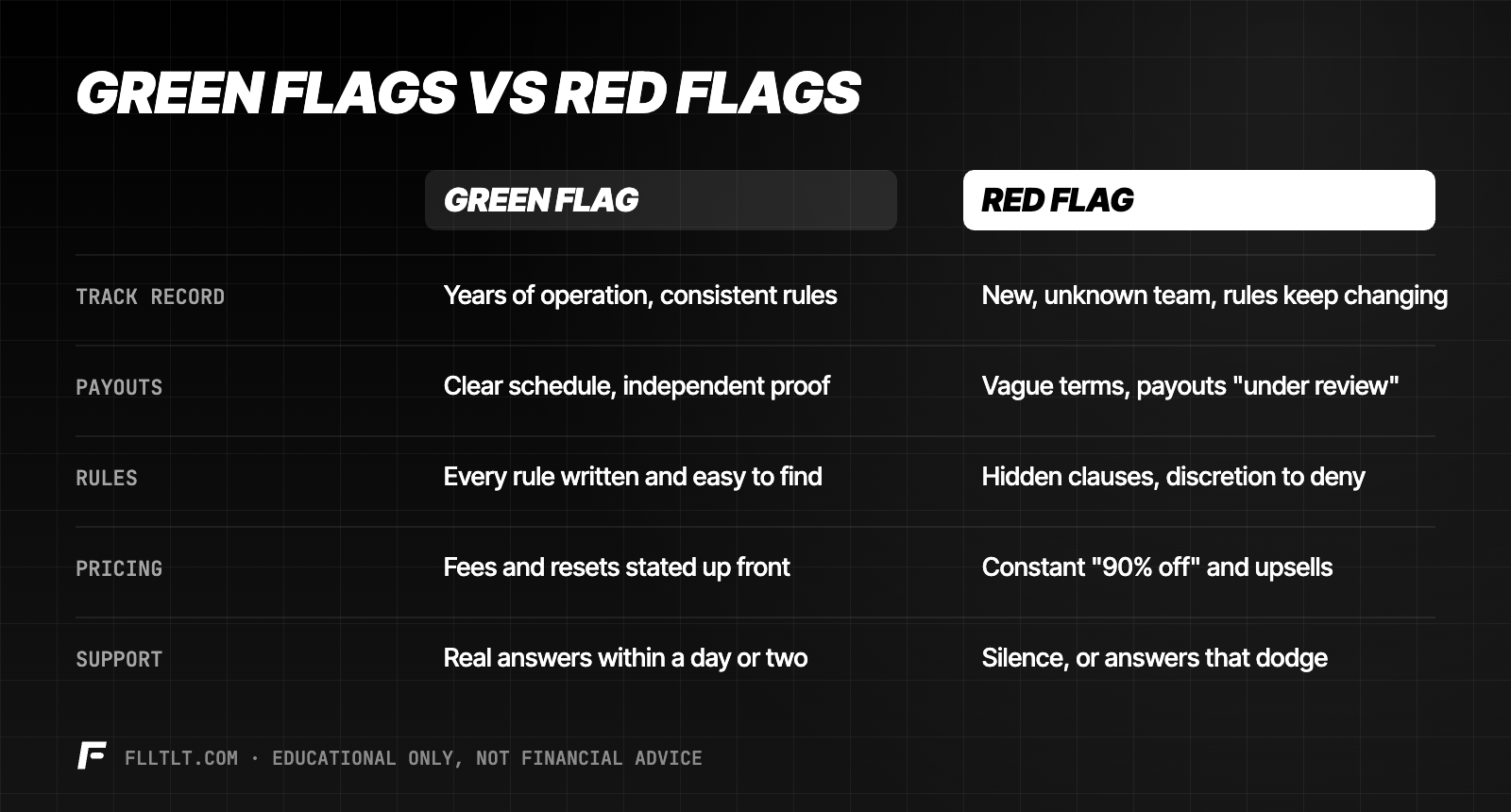
- Track record. How long has the firm operated, and have its core rules stayed stable?
- Payout proof. Look for payouts confirmed by real traders over time, not just screenshots the firm posts.
- Rules in writing. Every rule, including drawdown, daily loss limits and consistency rules, should be in one place you can read before paying.
- Payout terms. Read what can get a payout denied. Watch for broad language that lets the firm deny for almost any reason.
- Who runs it. A named team and a registered company are better than an anonymous brand.
- Support. Ask a question before you buy. How fast and how clearly they answer tells you a lot.
What are the biggest red flags?
Rules you can't find, payouts you can't verify and pressure to buy now. Constant deep discounts aren't proof of a scam, since most firms run sales. But a firm that seems to make all its money from failed evaluations, changes rules on active accounts or goes quiet when payout questions come up deserves a hard pass.
From the desk Indy trades futures in prop firm accounts and publishes a rules-based record in points on Day Trader Income. His rule of thumb: read the payout section of the terms before the rules section. The rules tell you how to pass. The payout terms tell you whether passing pays.
Is a prop firm worth it?
It can be, if you treat the fee as tuition and trade with a plan. Evaluations give you access to more buying power than most new traders have, with a loss capped at the fee. The catch is that most people who buy one don't pass, usually because of risk, not strategy. If you go in, go in with a risk plan and a clear read of the rules. For the full picture, start with our prop firm trading guide.
The bottom line
"Legit" isn't a yes-or-no for a whole industry. It's a question about one firm. Check the track record, the payout terms and the support before you pay, only spend what you can afford to lose, and remember that a funded account is a business relationship with a company, not money in your own brokerage account.
Fulltilt isn't affiliated with any firm named in this article. This is general education, not financial or legal advice.
FAQ
Are prop firms legit?
Many are legitimate businesses that have paid traders for years, but the industry is lightly regulated and some firms have closed suddenly. Check track record, payout proof, rule clarity and support before paying.
Are prop firm accounts real money?
Many evaluation and funded accounts are simulated. Profit splits are paid by the firm from its own business rather than from trades on a live exchange.
Are prop firms regulated?
Most evaluation prop firms are not regulated like brokers, because they describe their product as an assessment or education service. Traders usually do not get broker-level protections.
What happened to My Forex Funds?
The CFTC sued its parent company, Traders Global Group, in 2023 and its operations were frozen. In May 2025 a federal judge dismissed the case with prejudice and sanctioned the CFTC.
Is it worth paying for a prop firm evaluation?
It can be if you treat the fee as money you can afford to lose and trade with a risk plan. Most people who buy evaluations do not pass, usually because of risk management.