Market vs Limit Orders: Which Should You Use?
How market and limit orders work, when each one makes sense for day traders and where stop orders fit in.
On this page

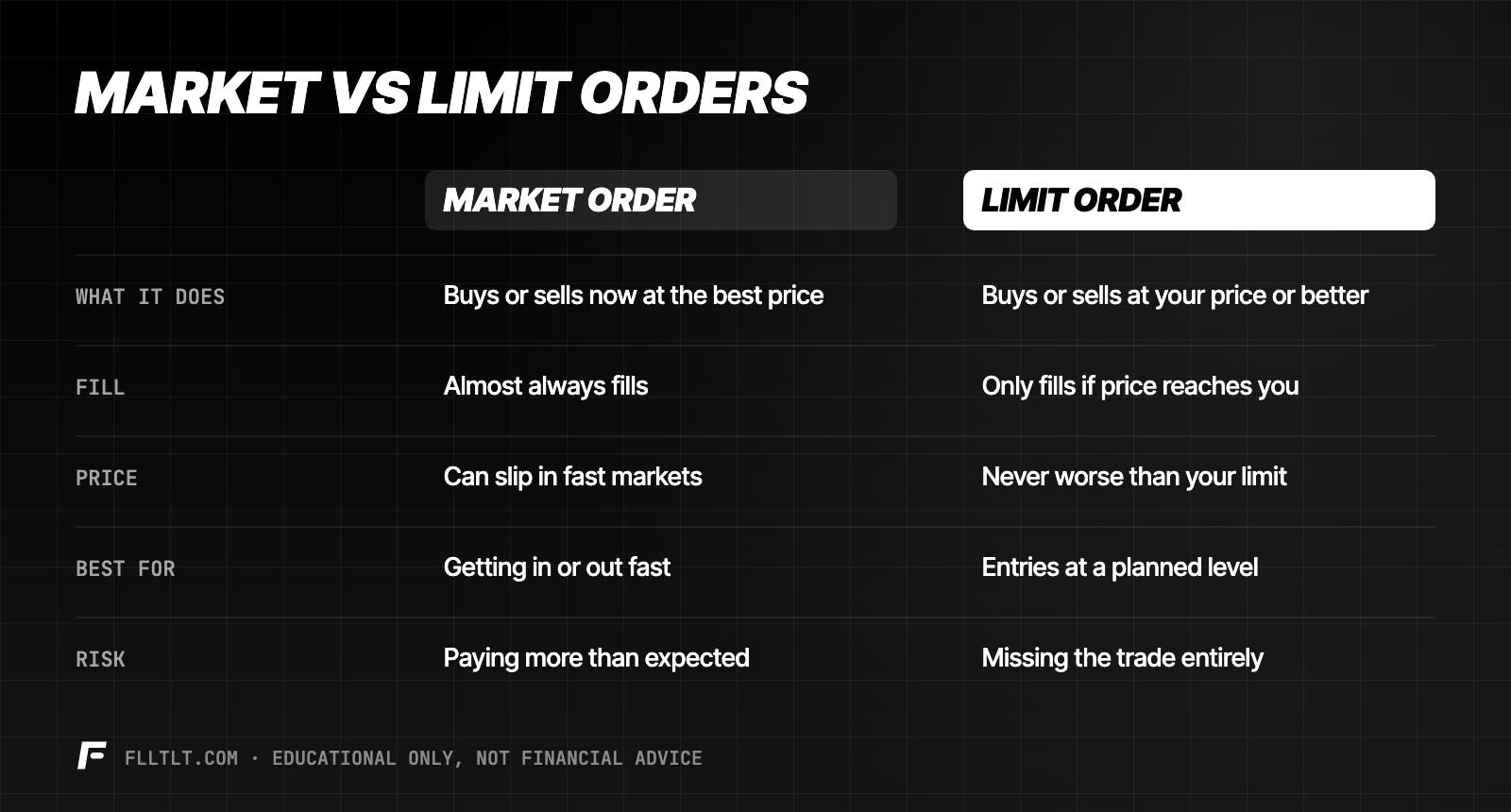
The short answer: A market order buys or sells immediately at the best price available, so it almost always fills but the price can slip in a fast market. A limit order buys or sells only at your chosen price or better, so you control the price but might not get filled. Day traders often use limit orders to enter at planned levels and market or stop-market orders when they need to get out fast.
Key takeaways
- Market order: certainty of fill, not of price.
- Limit order: certainty of price, not of fill.
- Buy limits sit below the current price. Sell limits sit above it.
- Exits that protect you, like stops, usually need to fill no matter what.
- In thin or fast markets, the difference matters most.
What's the difference?
How does a market order work?
It takes whatever price is available right now. If you buy MNQ with a market order, you pay the best offer in the order book. In calm, liquid markets that's usually the price you see. During news or fast moves, you can fill a few ticks worse. That difference is called slippage.
How does a limit order work?
It waits for your price. A buy limit at 20,000 only fills at 20,000 or lower. If price never comes back to 20,000, you never get in. That's the trade-off: you never overpay, but you can miss the move.
Many traders use buy limits at support or at VWAP on a pullback, so the entry is at the level they planned.
What about stop orders?
A stop order triggers when price reaches a level, then becomes a market or limit order. Stop-market orders are the usual way to protect a trade, because they fill even if price is moving fast. See stop loss orders explained.
Which should a day trader use?
| Situation | Common choice |
|---|---|
| Entering at a planned level | Limit order |
| Entering a breakout that's moving | Market or stop-market order |
| Taking profit at a target | Limit order |
| Protective stop | Stop-market order |
| Getting out fast | Market order |
From the desk Indy trades MNQ and records results in points on Day Trader Income. Recording fills in points makes slippage visible. If market orders keep costing a point or two, that's a real cost worth tracking.
The bottom line
Use limit orders when the price matters most and market orders when getting filled matters most. For protection, make sure your stop will actually fill. Practice placing all three on a simulator before you need them live.
FAQ
What is the difference between a market order and a limit order?
A market order fills immediately at the best available price, while a limit order only fills at your chosen price or better and may not fill at all.
Do limit orders always fill?
No. A limit order only fills if price reaches your limit. If price never trades there, the order stays unfilled.
Can a market order fill at a bad price?
Yes. In fast or thin markets a market order can fill several ticks away from the last price. This is called slippage.
Which order type is best for a stop loss?
Most traders use stop-market orders for stops, because they fill even when price is moving fast.