Range Trading Strategy: How to Trade a Sideways Market
How to spot a trading range, buy the bottom and sell the top with stops outside, and know when the range is about to break.
On this page
The short answer: Range trading means buying near the bottom of a sideways market and selling near the top, on the idea that price will keep bouncing between the two edges. It works when a market has no clear trend and has tested both edges more than once. Stops go just outside the range, because a real breakout means the idea is over.
Key takeaways
- Ranges form when neither buyers nor sellers are in control.
- Buy near support, sell near resistance, avoid the middle.
- Stops go just outside the range edges.
- A range needs at least two touches on each side to be worth trading.
- Every range eventually breaks. Have a plan for when it does.
What is a trading range?
A sideways market with a clear ceiling and floor. Instead of the higher highs and higher lows of a trend, highs and lows overlap. See how to identify a trend to tell the difference.
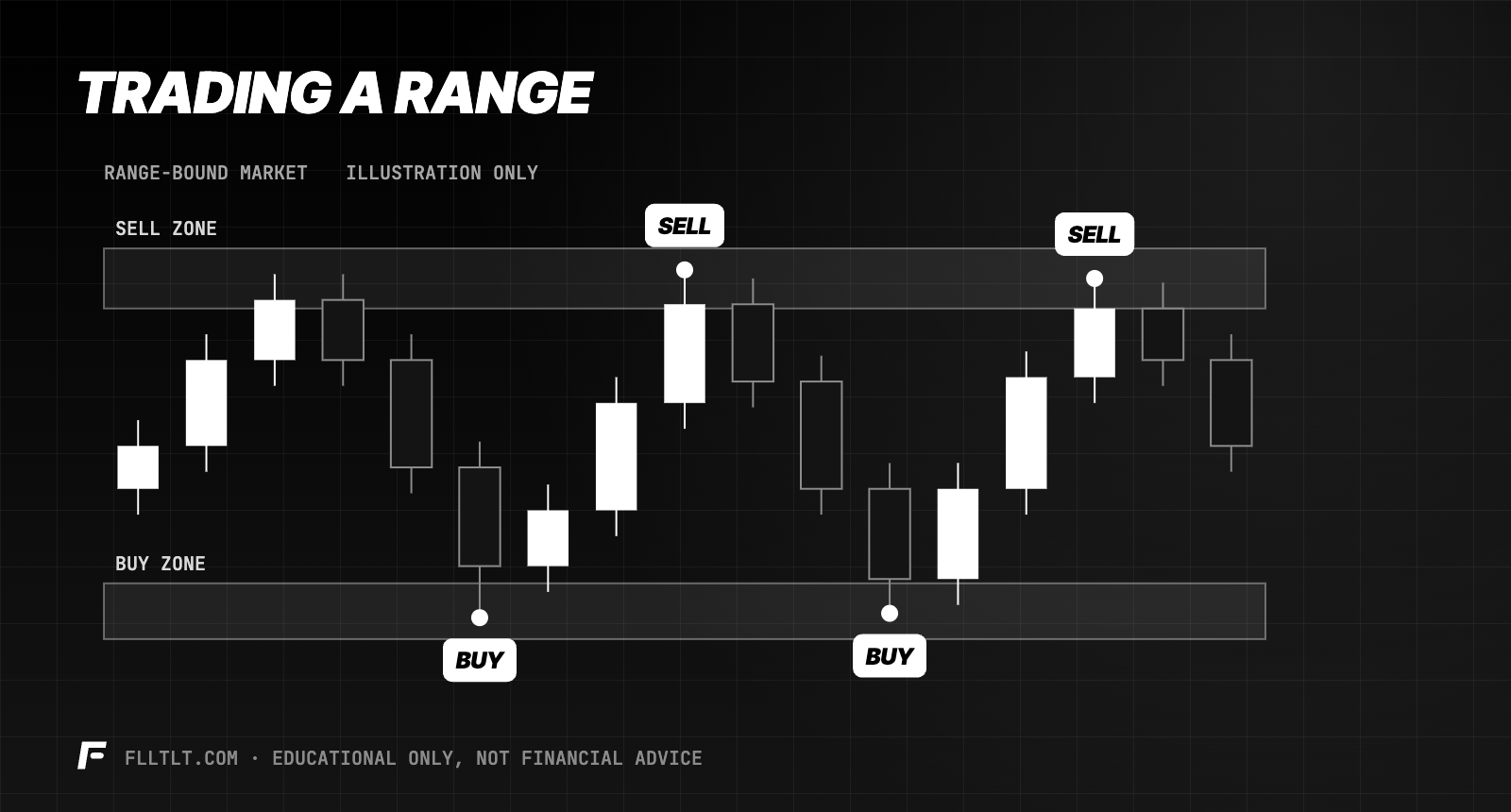
How do you trade a range?
- Confirm the range. At least two clear tests of the top and the bottom.
- Mark the zones. Treat each edge as a zone a few ticks wide, not a single line.
- Wait for price at an edge. Look for a rejection: a long wick or a candle closing back inside.
- Stop outside the range. A few ticks beyond the edge you're trading against.
- Target the other side, or the middle. Many traders take partial profit at the midpoint.
When does range trading fail?
- Breakouts. The third or fourth test of an edge often breaks. See why levels break.
- Narrow ranges. If the range is barely bigger than your stop, the risk-reward doesn't work.
- News. Scheduled data can blow through both edges.
- Trading the middle. Entries in the center of a range have no edge and no logical stop.
Range trading vs breakout trading
They're opposite bets on the same chart. Range traders bet the edges hold. Breakout traders bet they fail. Many traders do both: fade the edges while the range holds, then trade the break-and-retest once it doesn't. Compare approaches in the day trading strategies guide.
From the desk Indy trades MNQ and records results in points on Day Trader Income. Midday index futures often turn into a range. Knowing that ahead of time is a good reason to trade less in the middle of the day, or not at all.
The bottom line
When there's no trend, trade the edges with stops just outside, and stay out of the middle. When the range finally breaks, stop fading it.
FAQ
What is range trading?
Range trading means buying near the bottom of a sideways market and selling near the top, expecting price to keep moving between the two edges.
Where do you put a stop when range trading?
Just outside the range edge you are trading against, since a real breakout means the range idea is over.
How do you know a market is in a range?
Highs and lows overlap instead of trending, and price has tested both the top and bottom at least twice.
When does range trading stop working?
When the range breaks, often on the third or fourth test of an edge, or when news pushes price through.