What Is Slippage in Trading? (And How to Reduce It)
What slippage is, what causes it, how much it really costs across many trades and practical ways to reduce it.
On this page
The short answer: Slippage is the difference between the price you expected and the price your order actually filled at. It happens most with market and stop-market orders in fast or thin markets. On MNQ, one point of slippage costs $2 per contract. That sounds small, but across hundreds of trades it can turn a slightly profitable strategy into a losing one.
Key takeaways
- Slippage = expected price − actual fill price.
- It's most common during news, at the open and in thin overnight markets.
- Market and stop orders can slip. Limit orders can't, but may not fill.
- Track it. It's a real cost, like commissions.
- Build a tick or two of slippage into your sizing.
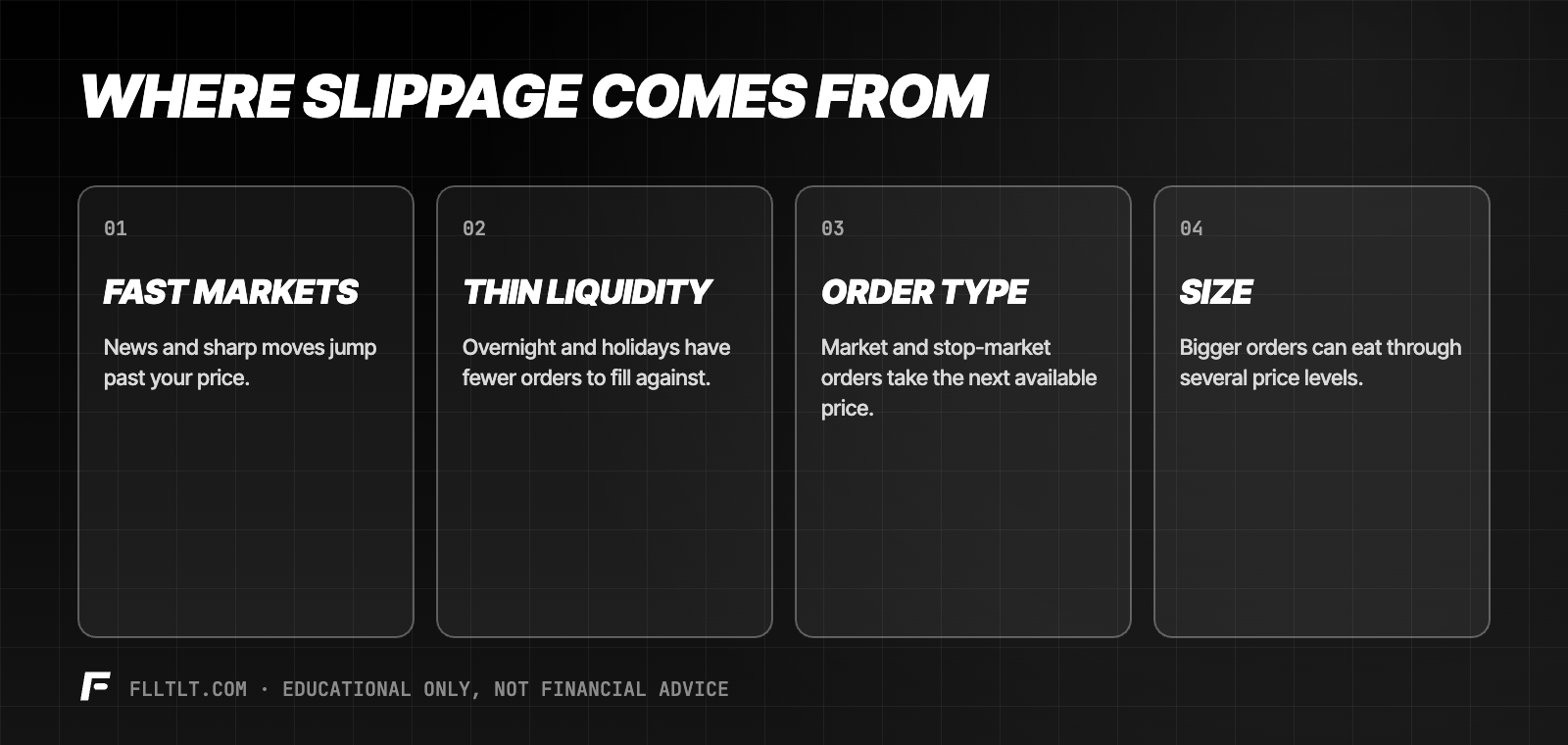
What causes slippage?
How much can slippage cost?
| Slippage per trade | Contracts | Cost per trade | Cost over 100 trades |
|---|---|---|---|
| 1 point MNQ ($2/pt) | 4 | $8 | $800 |
| 1 tick ES ($12.50) | 1 | $12.50 | $1,250 |
| 2 ticks MES ($1.25 each) | 5 | $12.50 | $1,250 |
If a strategy's expectancy is +$15 a trade before costs, $8 to $12 of slippage takes most of it.
Is slippage always bad?
No. Positive slippage happens too, when you fill at a better price than expected. But on stops during fast moves, it's usually against you, because everyone is trying to get out at once.
How can you reduce slippage?
- Use limit orders for entries and targets where the exact price matters.
- Avoid entering right at big data releases. Spreads widen and fills jump.
- Trade liquid contracts and hours. Index futures during U.S. regular hours have deep order books.
- Keep stops as stop-market. A little slippage on a stop is better than no fill.
- Size for it. Add a tick or two to your stop distance when sizing.
Does slippage happen in prop firm accounts?
Yes, and often on purpose. Many simulated funded accounts model slippage on market and stop orders so results are closer to live trading. Expect it in evaluations too.
From the desk Indy trades MNQ and records results in points on Day Trader Income. Comparing planned stop to actual fill, in points, is a quick way to see how much slippage is really costing.
The bottom line
Slippage is a cost you can't avoid completely but can reduce: trade liquid hours, use limit orders where price matters, avoid the second after big news and size with a small buffer. Then track it, because what you don't measure quietly eats your edge.
FAQ
What is slippage in trading?
Slippage is the difference between the price you expected and the price your order filled at.
What causes slippage?
Fast markets, thin liquidity, market and stop-market orders, and large order sizes are the most common causes.
Can limit orders slip?
No. A limit order only fills at your price or better, but it may not fill at all.
How do I reduce slippage?
Trade liquid contracts during busy hours, avoid entering right at major data releases, use limit orders where price matters and include a small buffer when sizing.