Trading Expectancy: The Formula That Shows If You Have an Edge
How to calculate expectancy from win rate and average win and loss, why high win rates can still lose money and how many trades you need.
On this page
The short answer: Expectancy is the average amount a strategy makes or loses per trade over many trades. It's calculated as (win rate × average win) − (loss rate × average loss). A positive number means the strategy has made money on average; a negative number means it hasn't, no matter how good individual trades feel. It combines risk-reward and win rate into one number.
Key takeaways
- Expectancy = (win % × average win) − (loss % × average loss).
- It's an average over many trades, not a promise for the next one.
- A low win rate can still be profitable with large enough winners.
- You need a decent sample, at least 30 trades, before trusting it.
- Costs like commissions and slippage come off the top.
How do you calculate expectancy?
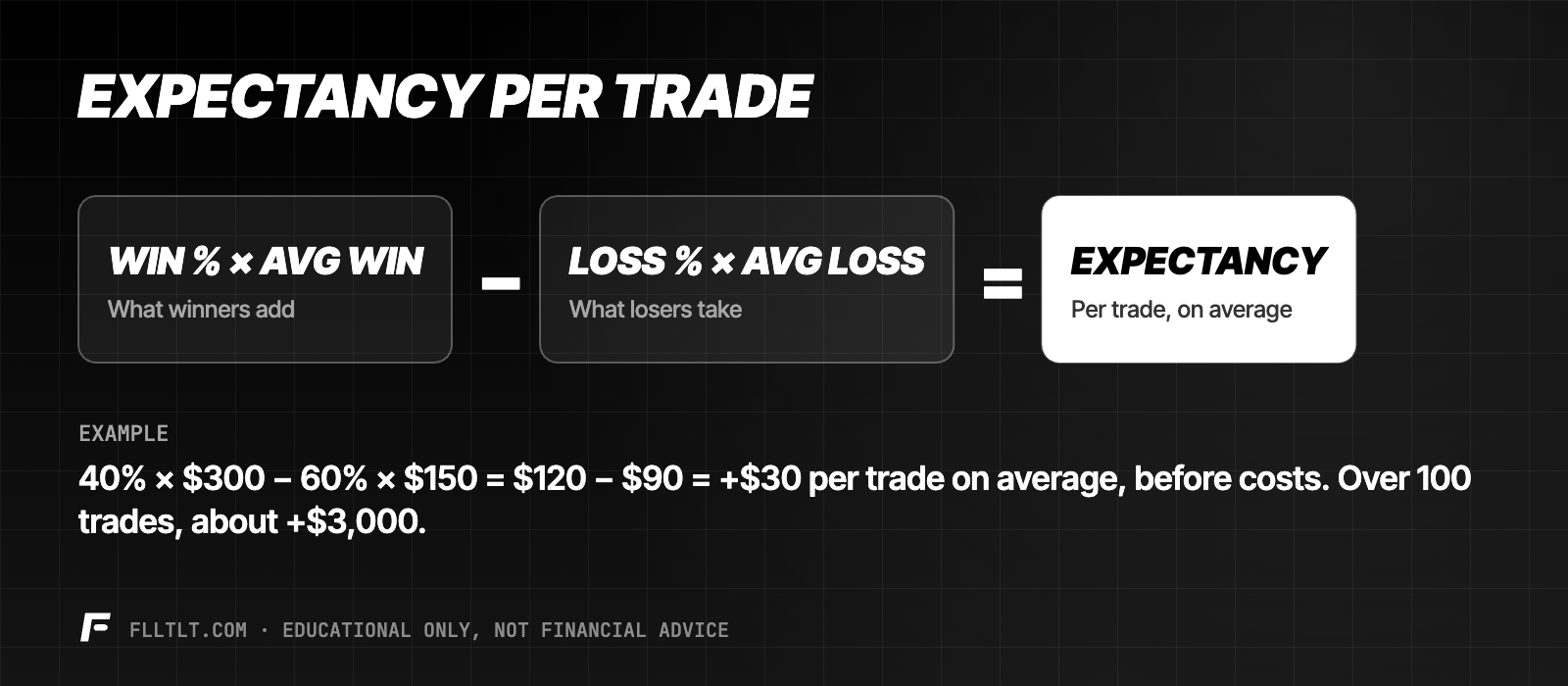
In the example, the trader wins only 40% of the time but still averages +$30 per trade, because winners are twice the size of losers.
How do win rate and size combine?
| Win rate | Avg win | Avg loss | Expectancy |
|---|---|---|---|
| 40% | $300 | $150 | +$30 |
| 60% | $100 | $150 | $0 |
| 70% | $100 | $300 | −$20 |
| 50% | $200 | $150 | +$25 |
Notice the 70% win rate that loses money. A high win rate means nothing if the losses are much bigger than the wins, often because of a stop that keeps getting moved.
How many trades do you need?
More than you'd like. Ten trades can look amazing or terrible by luck alone. Track at least 30, and ideally 100, before deciding a strategy works. A simulator lets you build that sample without risking money.
Why does expectancy matter in a prop firm?
Because positive expectancy isn't enough if the swings are too big. A strategy can average +$30 a trade and still hit a trailing drawdown during a normal losing streak if size is too large. Expectancy tells you the edge. Risk per trade decides whether you survive long enough to collect it.
From the desk Indy trades MNQ and publishes results in points on Day Trader Income. A public record is really an expectancy record: every win and every loss, so the average is honest.
The bottom line
Expectancy is the scoreboard for a strategy. Calculate it from real trades, give it a big enough sample, subtract costs, and size small enough to survive the swings while the average plays out.
FAQ
What is expectancy in trading?
Expectancy is the average profit or loss per trade over many trades, calculated as win rate times average win minus loss rate times average loss.
What is a good expectancy?
Any positive expectancy after costs means the strategy has made money on average. The size matters relative to your risk per trade.
Can a strategy with a low win rate be profitable?
Yes. With a 40% win rate, winners twice the size of losers produce positive expectancy.
How many trades do I need to measure expectancy?
At least 30 trades, and ideally 100 or more, since small samples are heavily affected by luck.